| Quality | Deploy | Docs |
|---|---|---|


|



|


|
GEMC, the GEant Monte-Carlo, is a database-driven Geant4 application for detector and radiation-transport simulations. It keeps detector descriptions outside the compiled C++ application:
- users builds setups in Python
- GEMC loads those definitions at run time and executes the Geant4 simulation pipeline
The goal is to make Geant4-based simulation accessible to users who want to prototype detector systems without writing a custom Geant4 application, while still preserving C++ extension points for advanced detector response and output workflows.
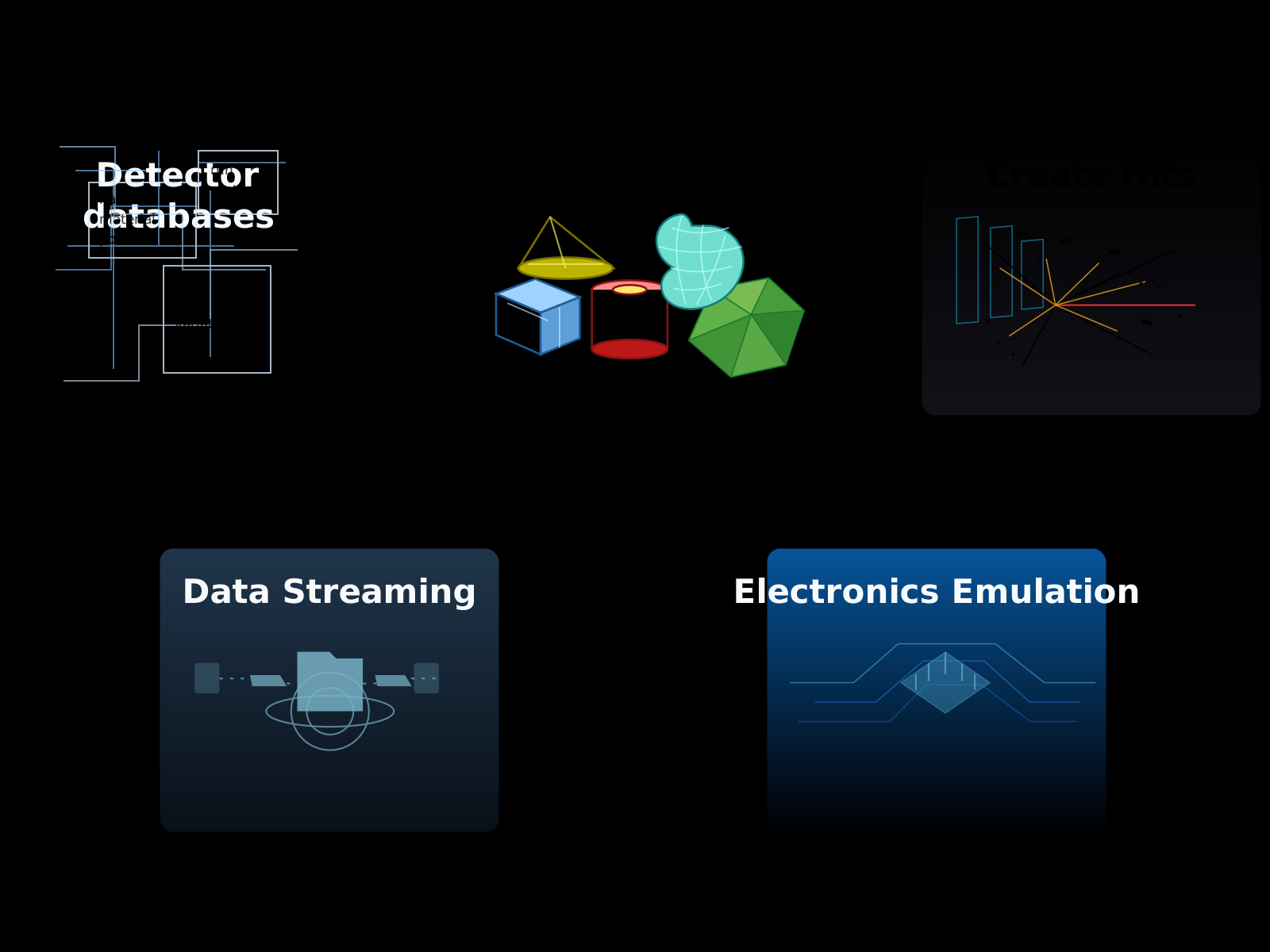
- Python-first detector definitions through
pygemc - Geometry and material storage in SQLite or ASCII databases
- Geometry imports from GDML, CAD meshes
- Run-number and geometry variations
- Built-in sensitive types:
flux,gPhotonDetector,dosimeter,particle_counter - C++ plugin infrastructure for custom digitization, fields, generators, and output streamers
- Event generation from command-line/YAML particle definitions and LUND files
- Supported output formats: ASCII, CSV, JSON, ROOT
- Magnetic-field support, including multipoles field and ascii maps
- Interactive Geant4/Qt visualization and off-screen image generation
- PyVista geometry preview, VTK export
- Python analyzer CSV and ROOT formats
- Meson-based C++ build with CI-tested Docker images for Linux
amd64andarm64
The fastest way to try GEMC is through the examples:
A minimal local workflow that creates a counter detector and runs 1000 events throught it:
gemc-system-template -s counter
cd counter
./counter.py
gemc counter.yaml -n=1000
gemc-analyzer counter_t0_digitized.csv totEdep --kind csv --bins 50
The template command creates a counter system,
the Python script builds the geometry and stores it in a SQLite file gemc.db,
gemc runs the simulation, and gemc-analyzer plots a variable from the CSV output.
For installation instructions see the installation guide
Detector systems are build and written to databases using pygemc.
An example of definiting a sensitive flux box:
from pygemc import GVolume, autogeometry

cfg = autogeometry("examples", "counter")

flux = GVolume("flux_box")
flux.description = "air flux box"
flux.make_box(40.0, 40.0, 2.0)
flux.set_position(0, 0, 100)
flux.material = "G4_AIR"
flux.color = "3399FF"
flux.digitization = "flux"
flux.set_identifier("box", 2)
flux.publish(cfg)
Geometry scripts can write SQLite or ASCII databases, display geometry with PyVista, or export VTK.js files:
./counter.py --factory sqlite
./counter.py -pv
./counter.py -pvvtk counter -pvz 0.25
PyVista is part of the normal GEMC geometry workflow. It lets users inspect detector geometry before running Geant4, export portable VTK.js scenes for documentation, and catch placement or rotation mistakes while editing Python geometry scripts. Some examples:
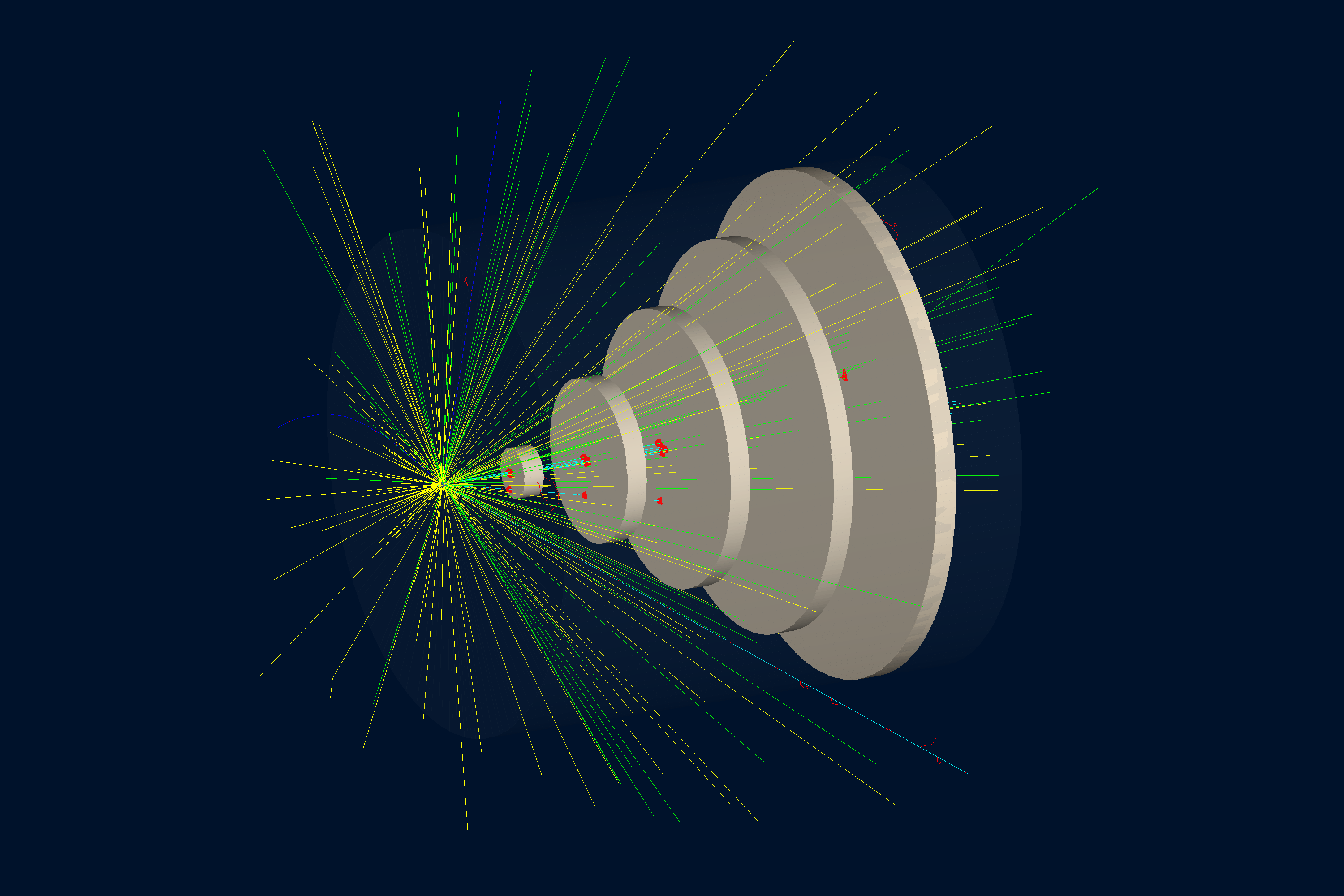 Geant4 basic/b2 |
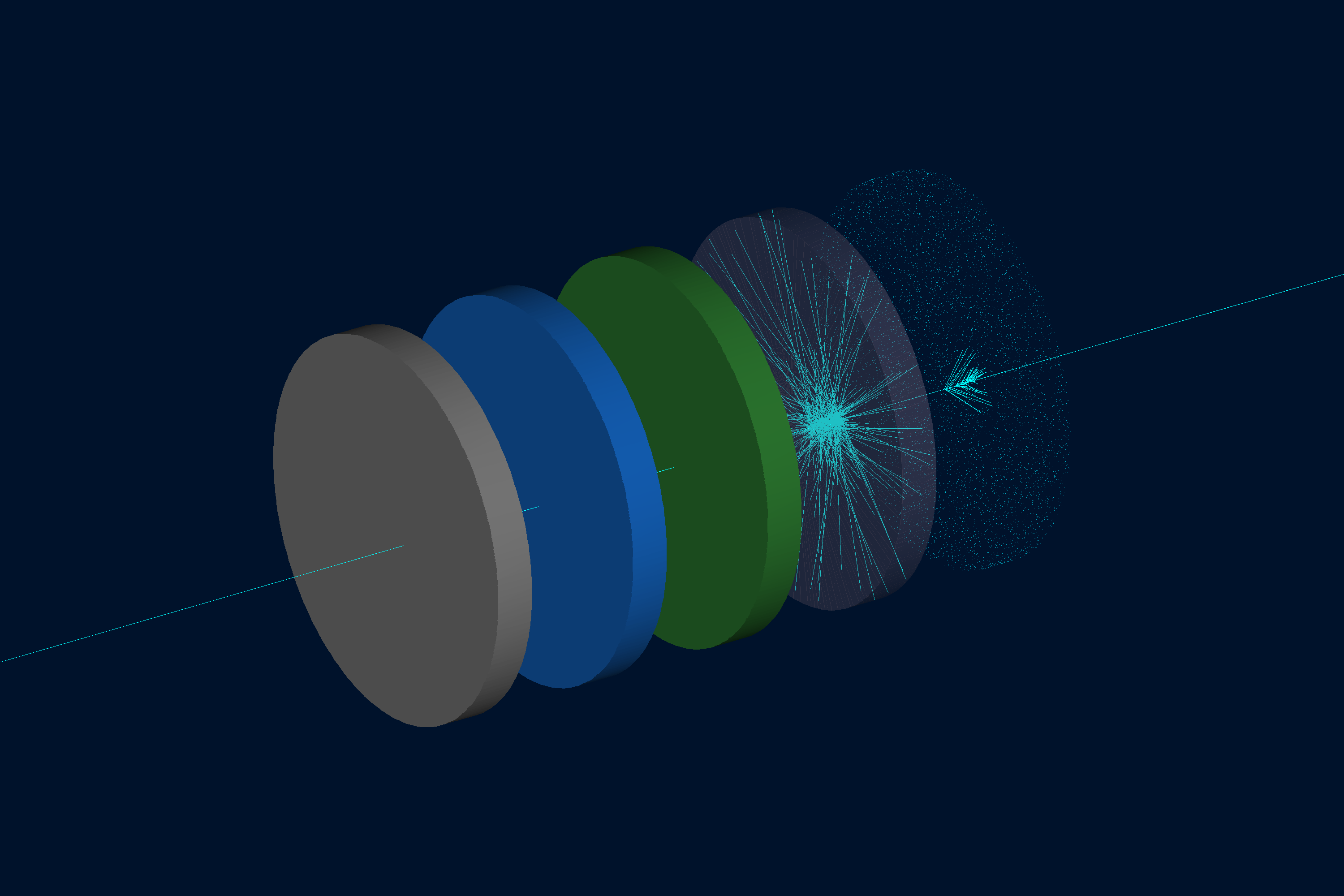 Materials |
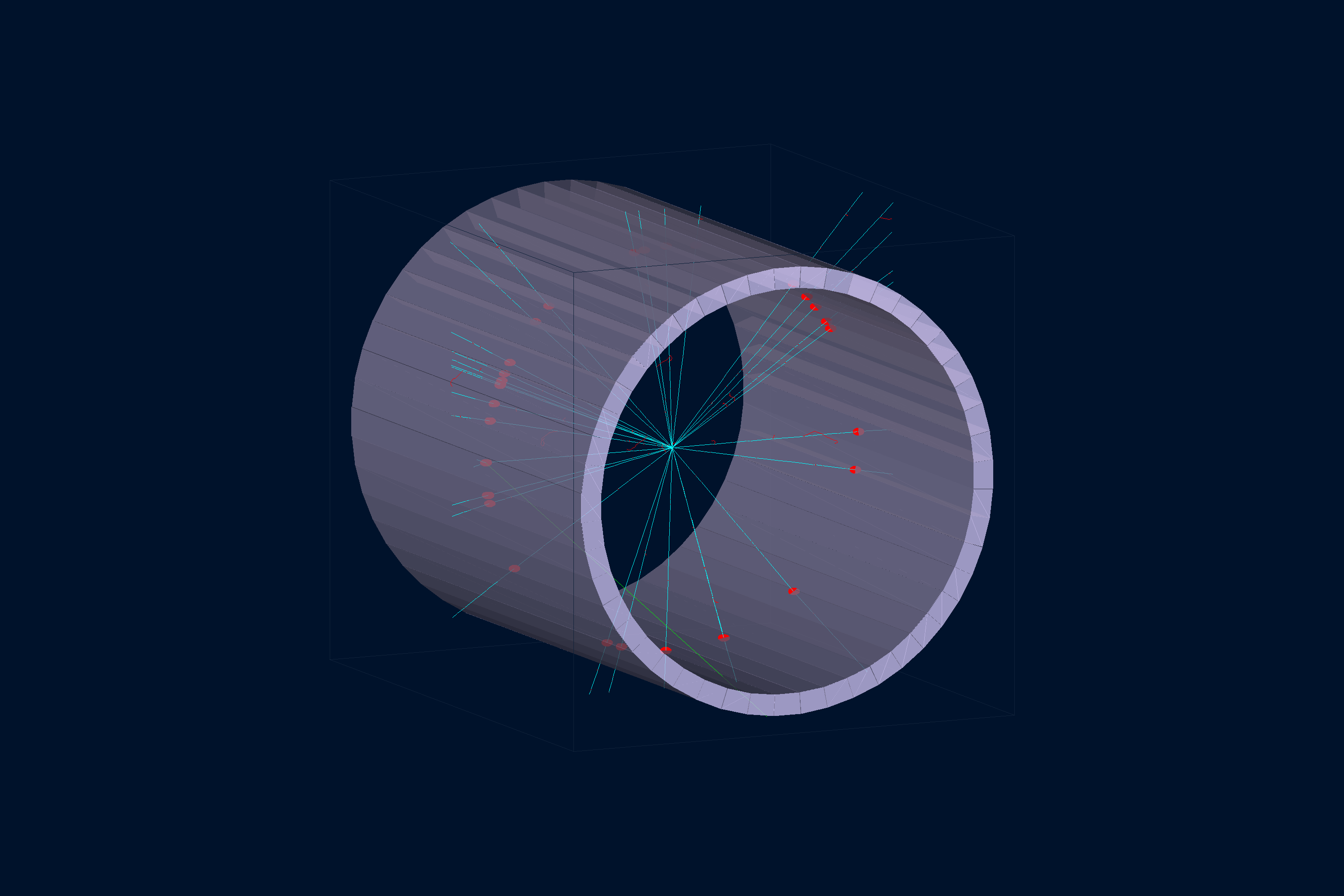 Scintillator Barrel |
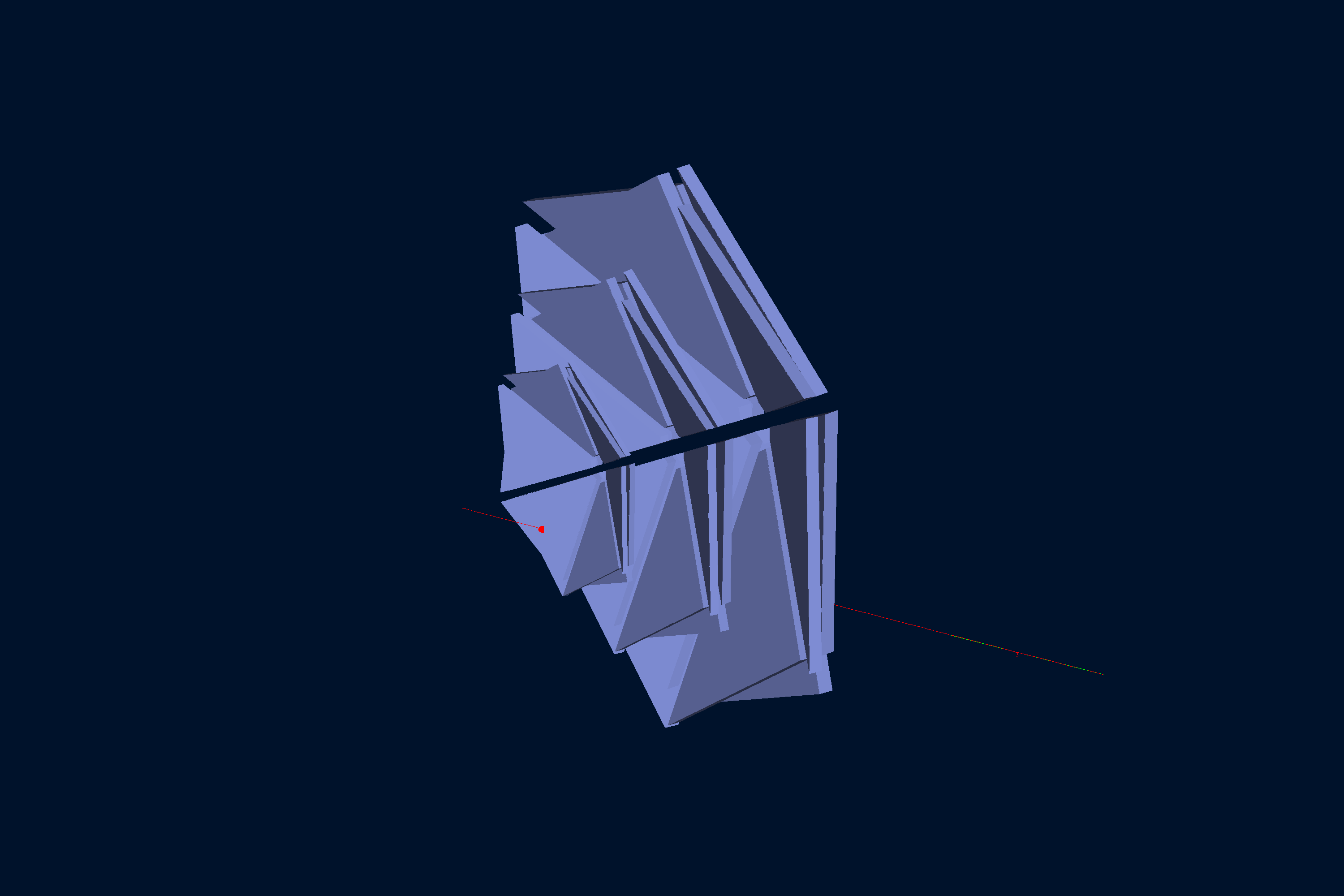 CLAS12 DC |
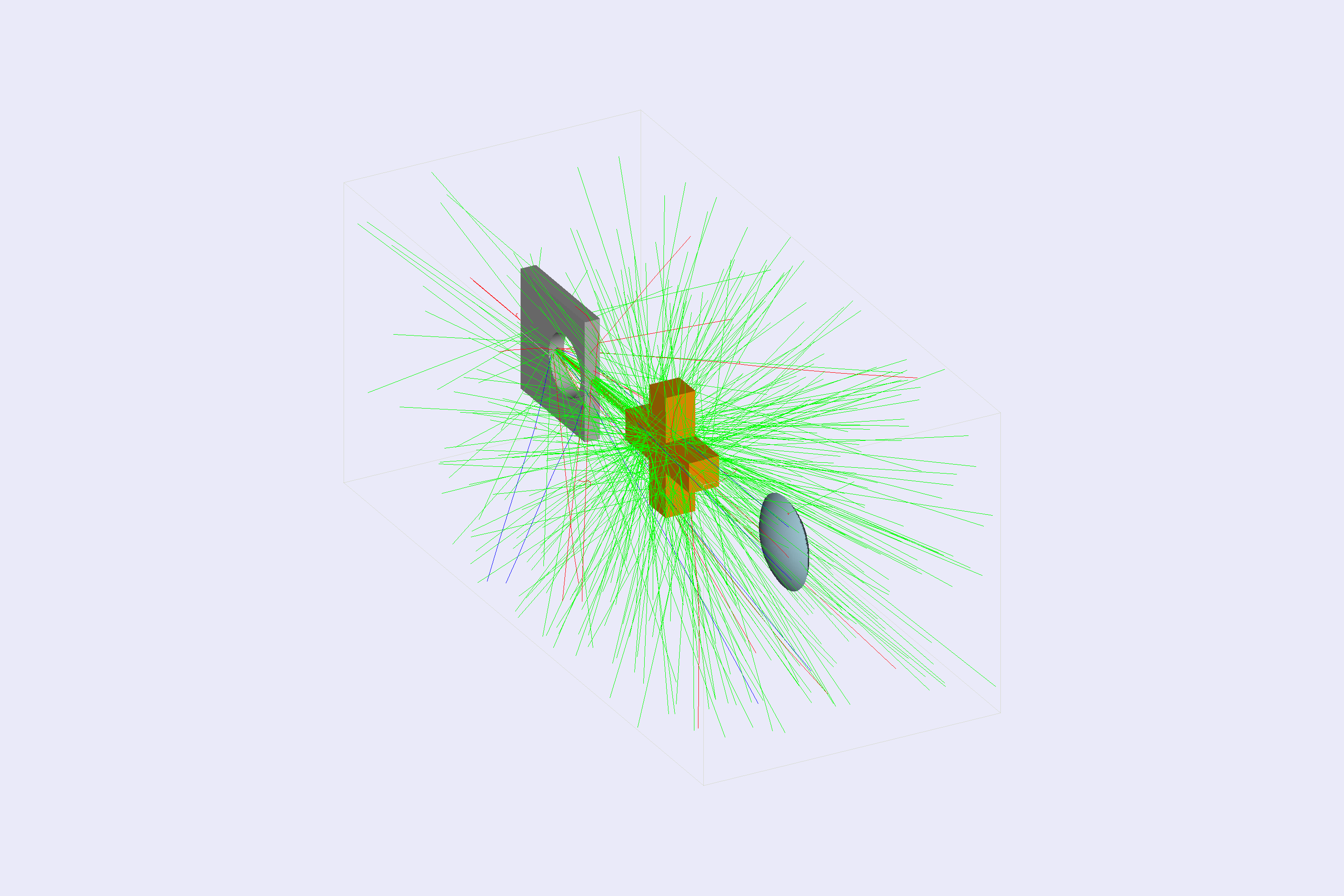 Boolean Solids |
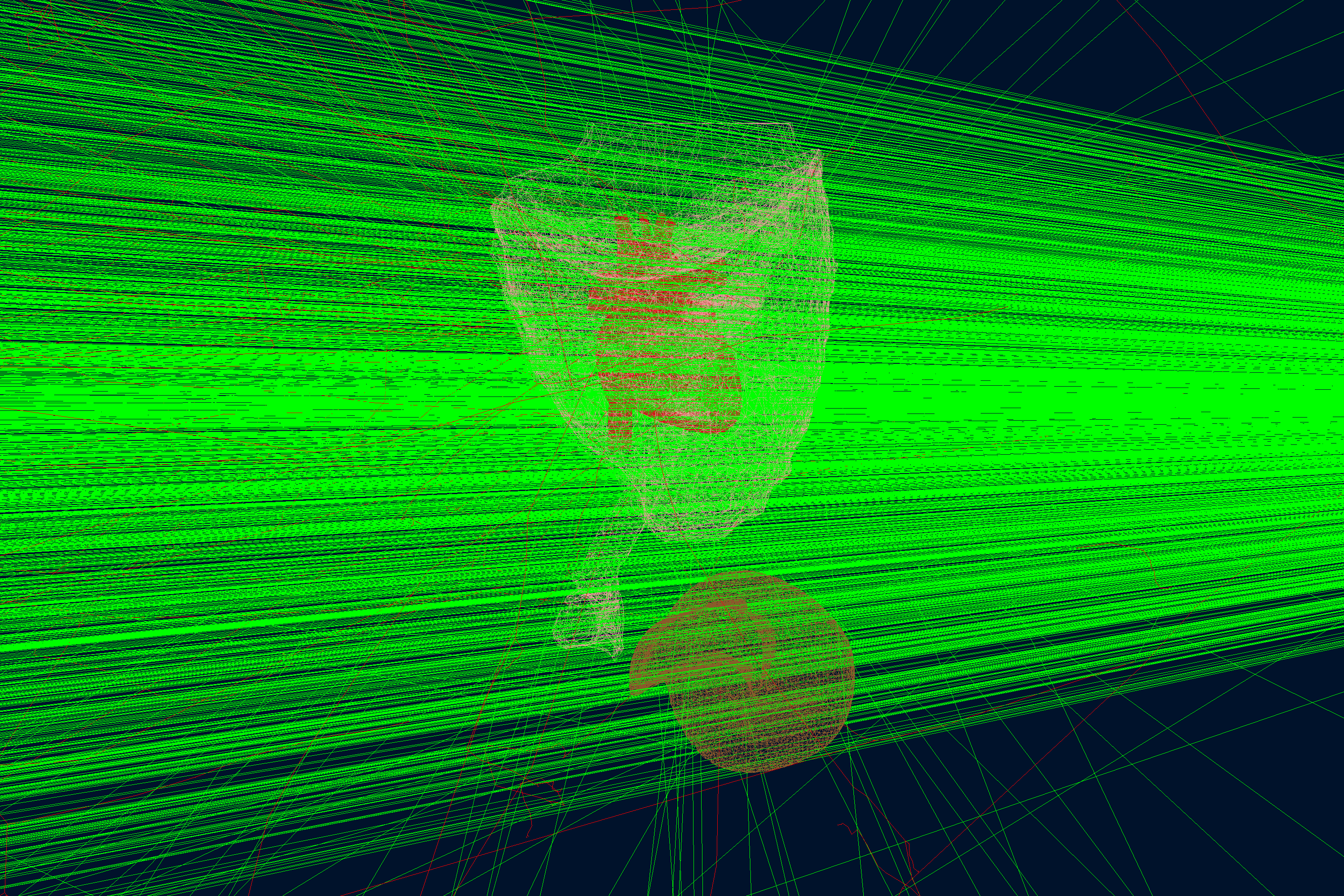 CAD Import |
Open the linked interactive PyVista scenes generated from the GEMC examples.
GEMC is configured with YAML files and equivalent command-line options. A compact steering file can define the run number, event count, generator, geometry systems, output streamers, and world volume:
runno: 1
n: 100
nthreads: 1

gparticle:
  - name: proton
    p: 1500
    vz: -5.0

gsystem:
  - name: counter
    factory: sqlite

gstreamer:
  - filename: counter
    format: csv
  - filename: counter
    format: root

root: G4Box, 15*cm, 15*cm, 15*cm, G4_AIR
Run in batch mode:
gemc counter.yamlRun with the Geant4 GUI:
gemc counter.yaml -guiExecute a Geant4 macro text file (upcoming in the next release):
gemc counter.yaml -geant4_macro=run.mac
gemc counter.yaml -gui -geant4_macro=vis.mac
The equivalent YAML setting is geant4_macro: run.mac. GEMC executes the macro after initialization and
visualization setup, before entering the GUI or interactive terminal. Relative paths use the working directory;
Geant4 handles comments, aliases, and nested /control/execute commands. Missing files and failed commands
produce a nonzero exit status.
In batch mode, the macro controls event generation with commands such as /run/beamOn 100; GEMC does not
automatically run the -n events or the -run_weights allocation afterward. Detector conditions are prepared
using -run. A visualization-only macro generates no events unless it contains a beam-on command. Without
geant4_macro, the usual event processing is unchanged.
Generate an off-screen Geant4 image:
gemc counter.yaml -n=10 \
  -g4view="[{driver: TOOLSSG_OFFSCREEN, segsPerCircle: 200}]" \
  -g4camera="[{phi: -10*deg, theta: 250*deg}]" \
-g4light="[{phi: 160*deg, theta: 120*deg}]"The output layer is plugin-based. Built-in streamer formats include:
| Format | Notes |
|---|---|
ascii |
Human-readable text output |
csv |
Per-thread CSV tables for digitized hits, true information, generated particles, and tracked generated particles |
json |
Structured event output |
root |
ROOT TTrees, available when GEMC is built with ROOT |
Upcoming in the next release, track provenance can be enabled for event output:
gemc counter.yaml -save_original_track
gemc counter.yaml -save_all_ancestors
-save_original_track populates otid in each true-information hit. -save_all_ancestors also enables
original-track IDs and writes a deduplicated ancestors bank containing each hit-producing track and its
complete parent chain. CSV output uses a separate _ancestors.csv file; ASCII, JSON, and ROOT include the bank
in their event output.
pygemc provides some utitlities to analyze CSV or ROOT output. For example:
gemc-analyzer counter_t0_digitized.csv totEdep --kind csv --bins 50
gemc-analyzer out.root E --kind root --detector flux --save energy.png
For example, after running the b2 example with
gemc b2.yaml -n=1000, the analyzer produces:
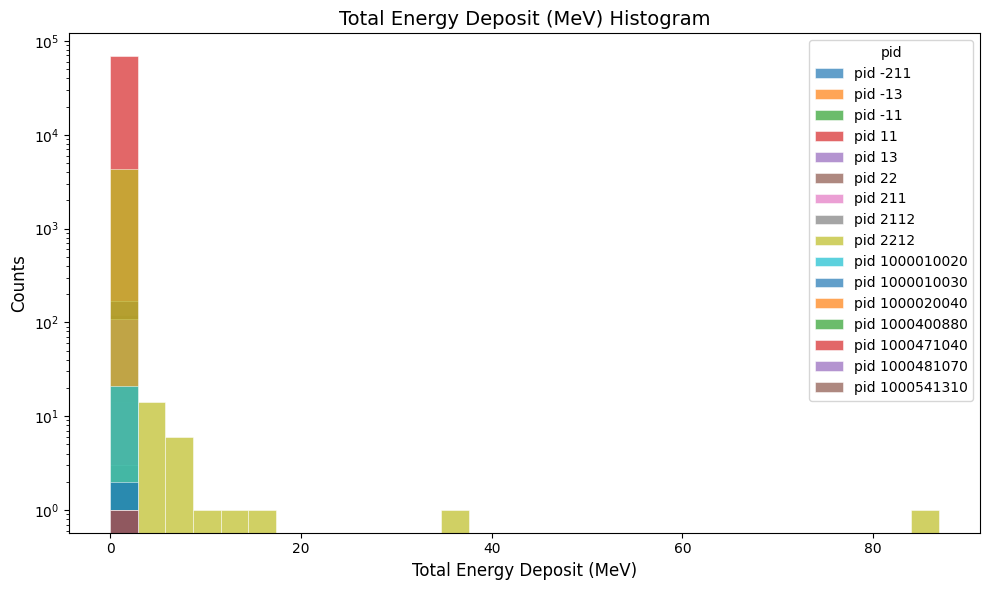
gemc-analyzer b2_t0_digitized.csv totEdep --kind csv
|
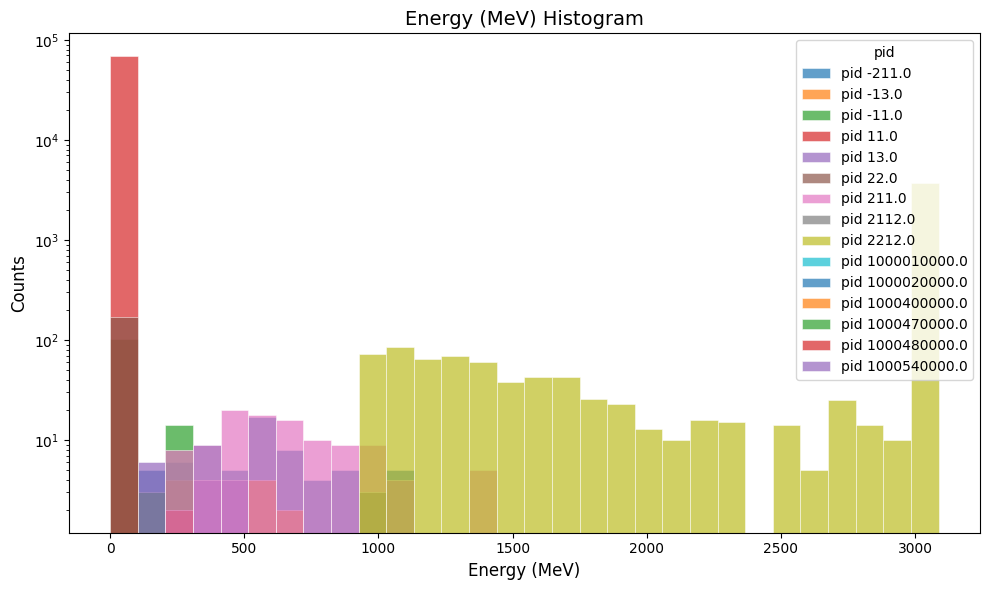
gemc-analyzer b2_t0_true_info.csv E --kind csv --data true_info
|
- GEMC homepage
- Thread scaling — multithread benchmarking and the scaling sweep
- Profiling — Valgrind callgrind metrics and how to read them
- Python API repository
- CLAS12 GEMC systems repository
Contributions are welcome through normal pull requests. Before opening a pull request, run the relevant Meson tests and keep changes focused. See:
If you use GEMC in scientific work, cite:
M. Ungaro and the CLAS Collaboration, "The CLAS12 Geant4 simulation," Nuclear Instruments and Methods in Physics Research Section A 959, 163422 (2020). https://doi.org/10.1016/j.nima.2020.163422
BibTeX and additional citation formats are in CITATION.md.
GEMC is licensed under the Apache License, Version 2.0; see NOTICE for attribution and
third-party acknowledgments. The software also depends on separately licensed third-party components, including
Geant4, CLHEP, Qt, ROOT, SQLite, and Assimp.
See the project roadmap for the current development plans.