
RadixView shows the KV cache of a running SGLang server. It subscribes to the server's ZMQ event stream, logs every block the server stores or evicts, and draws the resulting radix tree as a web page at http://<host>:8765.
A block is the unit a KV event reports: page_size tokens, multiplied by dcp_size when decode context parallelism is on.
RadixView can run on a different machine from the GPU server. It does not route requests, and it does not read the server's radix tree in-process.
Python 3.10 or newer.
pip install radixviewThis installs the radixview command. From a checkout of this repository, pip install -e . installs that same command from the working tree.
No GPU and no model required. The demo is part of the repository, not the pip package. From a checkout:
python -m examples.demoOpen http://127.0.0.1:8765, or http://<host>:8765 from another machine. The demo fills the tree with synthetic agent traffic: one shared system prompt, many sessions, a few regenerated turns, and eviction once the cache is full.
| Option | Default | Meaning |
|---|---|---|
--blocks |
400 |
How many blocks the cache keeps |
--port |
8765 |
Port for the page. 0 picks a free port |
Prompt text for the demo is in examples/demo/corpus.json, and the generator is examples/demo/traffic.py. The library imports neither.
Start SGLang with KV events bound on a wildcard host such as *:
python -m sglang.launch_server \
  --model-path MODEL_PATH \
  --kv-events-config '{"publisher":"zmq","endpoint":"tcp://*:5557"}'
SGLang binds its publisher only on a wildcard host. With a concrete host such as tcp://127.0.0.1:5557 it connects out instead, nothing can subscribe to it, and RadixView exits with a hint.
Then, from this machine or another one that can reach the server:
radixview --server http://GPU_HOST:30000| Option | Default | Meaning |
|---|---|---|
--server |
http://127.0.0.1:30000 |
Base URL of the SGLang HTTP server |
--api-key |
none | Needed when SGLang was started with --api-key |
--view-port |
8765 |
Port for the page, on every interface. 0 picks a free port |
Open http://<the host running RadixView>:8765.
RadixView reads /server_info to find one ZMQ endpoint per data-parallel (DP) rank, and turns stored token ids back into text through the server's /detokenize endpoint. The machine running RadixView must reach:
GPU_HOST:30000, the SGLang HTTP port.GPU_HOST:5557up to5557 + dp_size - 1, one ZMQ port per DP rank.
Each event is logged like this, shown without the timestamp and logger name:
dp=0 seq=42 stored blocks=1 tokens=64 block_size=64 medium=GPU parent=1137640873890580499 hash=-2285270490815386373
  User: How do I handle GPU quota?
dp=0 seq=43 removed blocks=2 medium=GPU hashes=[-2285270490815386373, 5188292320627455716]
dp=0 seq=44 cleared
A skipped sequence number is logged as a gap. A sequence number that goes backwards is logged as a publisher restart.
Start RadixView before the traffic you care about, or restart SGLang after RadixView is up. Blocks stored before RadixView subscribed are not in the stream. Their descendants hang off a dashed placeholder node.
The ZMQ events carry prompt token ids, and the page serves the decoded prompt text. Neither is encrypted or authenticated, and the page listens on every interface. Keep the ZMQ ports and --view-port on a trusted network.
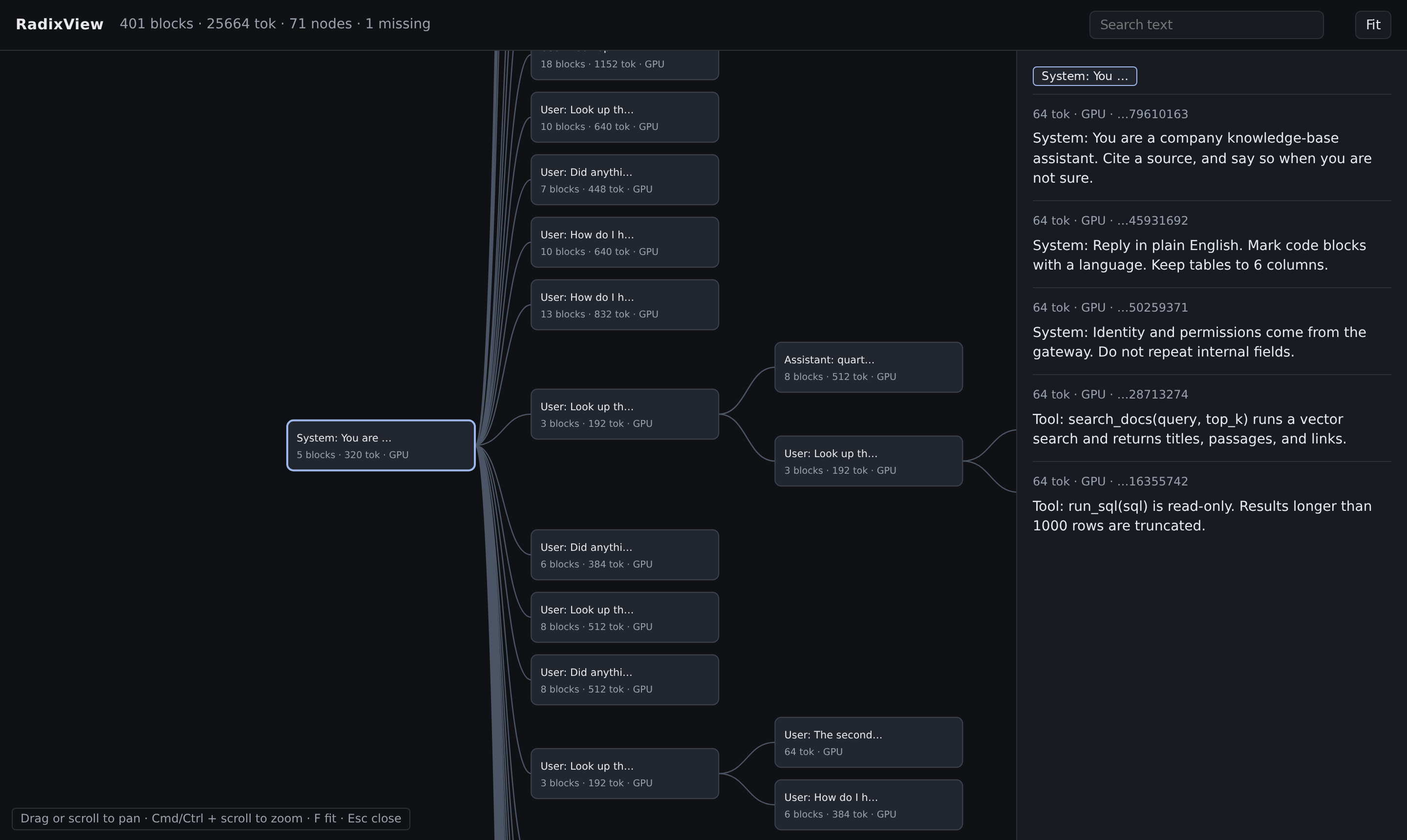
The tree reads left to right, like a prompt. A straight chain of blocks collapses into one node while those blocks sit on the same tiers. A branch, or a change of tier, starts a new node. Each node shows the start of its text, then its block count and token count. A bar on the left is blue for GPU memory and amber for host memory, split when the block is in both. SGLang HiCache reports host memory as CPU_PINNED; RadixView calls it CPU everywhere, including the API and the export. Tier names are upper-cased.
The header shows the logical size first, with each block counted once, then blocks and tokens per tier. A block in both GPU and CPU memory counts in both tiers. The GPU and CPU buttons dim a node, and the edges to it, when none of its tiers is switched on. While both are on, the tier filter dims nothing. DISK and EXTERNAL stay in the data with a neutral bar and have no button.
Click a node to open the side panel. It shows the path from the root and the full text of every block in the node, with the same bar. When a tier change splits or joins the node, the panel moves to the node that now holds its first block. The search box matches the full block text, not only the preview. Search hits are outlined in green, and the selected node and its path from the root in blue.
Export downloads radixview-node-blocks-v<version>.json, pretty-printed. The same document is GET /api/node-blocks. Each entry is one visual node: its id, the id of its parent node, its media, and blocks in prefix order. A block has its hash, the hash of its parent block, the decoded text, the token count, and media, a list such as ["GPU", "CPU"]. A node with "missing": true is a parent stored before RadixView subscribed; its blocks list is empty. stats.tiers counts blocks and tokens per tier. stats.missing counts missing parents.
{
  "version": 2,
  "stats": {
    "blocks": 2,
    "tokens": 128,
    "nodes": 1,
    "missing": 0,
    "tiers": {"GPU": {"blocks": 2, "tokens": 128}}
  },
  "nodes": [
    {
      "id": "7..8",
      "parent": null,
      "missing": false,
      "media": ["GPU"],
      "blocks": [
        {"hash": "7", "parent": null, "text": "User: How do I", "tokens": 64, "media": ["GPU"]},
        {"hash": "8", "parent": "7", "text": " handle GPU quota?", "tokens": 64, "media": ["GPU"]}
      ]
    }
  ]
}
Drag or scroll to pan. Cmd/Ctrl + scroll zooms. F fits the whole tree. Esc closes the side panel.
pip install -e ".[dev]"
pre-commit install
pre-commit run --all-files
python -m unittest discover -s tests
Style follows SGLang: Apache-2.0 file headers, ruff format at line length 88, isort with the black profile, and ruff rules F401, F821, F823, and UP037. Ruff's C901 keeps every function's cyclomatic complexity below 10.
The page tests run under Node, through tests/test_web.py, on snapshots generated from the demo. They are skipped when node is not installed. Running the page itself does not need Node. While working on the page, node tests/web/run.mjs runs them directly and skips the ones that need demo snapshots; python -m unittest discover -s tests -p test_web.py runs all of them.
| Path | Contents |
|---|---|
radixview/cli.py, config.py |
The radixview command and its options |
radixview/discover.py |
Finding ZMQ endpoints in /server_info |
radixview/fetch.py |
HTTP requests to SGLang. Loopback hosts skip http_proxy |
radixview/wire.py |
Decoding an event batch and formatting the log line |
radixview/subscribe.py |
The ZMQ subscriber |
radixview/text.py |
/detokenize |
radixview/tree.py |
The radix tree built from events |
radixview/server.py |
The page and /api/* |
radixview/serve.py |
Wiring the subscriber, the tree, and the page together |
radixview/web/ |
The page. No build step. Labels are in web/js/format.mjs |
examples/demo/ |
Synthetic traffic. Not part of the library |
tests/ |
Python tests. tests/web/ tests the page modules |
radixview/web/js/layout.mjs, viewport.mjs, render.mjs, and export.mjs are pure and have no DOM. main.mjs wires them to the page.
Apache License 2.0. See LICENSE.