RustThreadPool is a facility for processing a stream of messages with a function object concurrently on a specified number of threads, using a thread-safe blocking queue. The function object uses messages posted to RustBlockingQueue.
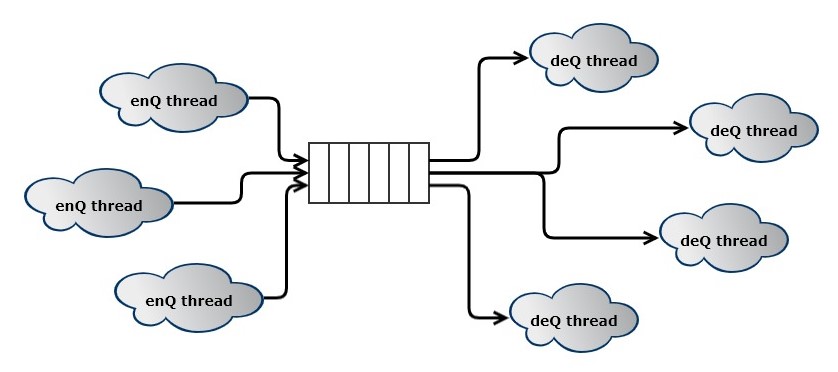
There is one struct, ThreadPool<M>, with three methods:
#[derive(Debug)]
pub struct ThreadPool<M> {
    sbq: Arc<BlockingQueue<M>>,
    thrd: Vec<Option<JoinHandle<()>>>
}

pub fn new<F>(nt: u8, f: F) -> ThreadPool<M>
where F: FnOnce(&BlockingQueue<M>) -> () + Send + 'static + Copy

pub fn wait(&mut self)

pub fn post_message(&mut self, _msg: M)
where M: Debug + Clone
Sharing between threads is only possible, due to rules of the Rust language, if shared items are Mutexes, Condvars, or aggregates of those. BlockingQueue<T> is shareable because its two fields are a Mutex<VecDeque<T>> and a Condvar.
ThreadPool<M> is parameterized over message type M: Send + 'static.
| Function | Signature | Description |
|---|---|---|
new |
fn new<F>(nt: u8, f: F) -> ThreadPool<M> |
Spawn nt threads, each running closure f against the shared queue |
post_message |
fn post_message(&mut self, msg: M) |
Enqueue a work item for any available worker |
get_message |
fn get_message(&mut self) -> M |
Stub - returns M::default() |
wait |
fn wait(&mut self) |
Block until all worker threads finish |
The closure bound F: FnOnce(&BlockingQueue<M>) + Send + 'static + Copy means workers share a Copyable function but each receive their own reference to the shared queue. Closures that capture Arc or other non-Copy values will not satisfy this bound; use non-capturing closures or bare function pointers instead.
The library does not provide a built-in shutdown mechanism. The standard approach is to post one poison-pill message per worker thread, where the worker breaks its loop on receiving it:
for _ in 0..num_threads {
    pool.post_message(WorkItem::default());
}
pool.wait();interface_demos/ contains a runnable binary crate generated by interface_demo_agent.py:
| File | Description |
|---|---|
src/rust_thread_pool_demos.rs |
Four demos covering all public API functions |
rust_thread_pool_interface.json |
Extracted interface description used by the agent |
generation_summary.json |
Agent run metadata |
Build and run the demos:
cd interface_demos
cargo run
Demos:
demo_basic_pool-new,post_message,waitwith 4 threads and 10 work itemsdemo_get_message-get_messagestub returningM::default()demo_string_pool-ThreadPool<StringMsg>showing generic type parameterdemo_stress_test- 8 threads, 200 messages
interface_demo_agent.py was run from the project root:
python interface_demo_agent.py c:\github\JimFawcett\RustThreadPool
It extracted the public interface from src/lib.rs, wrote rust_thread_pool_interface.json and rust_thread_pool_demo.rs into interface_demos/, and recorded generation_summary.json.
*****************************************************************
  rust_thread_pool - Public API Demonstration
*****************************************************************

=================================================================
Demo 1: new, post_message, wait
=================================================================

[Demo 1] posting 10 work items
[Demo 1] posting 4 shutdown signals
[Demo 1] waiting ...
  [Worker ThreadId(3)] id=3 payload="task-3"
  [Worker ThreadId(4)] id=2 payload="task-2"
  [Worker ThreadId(2)] id=1 payload="task-1"
  [Worker ThreadId(5)] id=4 payload="task-4"
  [Worker ThreadId(4)] id=6 payload="task-6"
  [Worker ThreadId(5)] id=8 payload="task-8"
  [Worker ThreadId(3)] id=5 payload="task-5"
  [Worker ThreadId(3)] shutdown
  [Worker ThreadId(2)] id=7 payload="task-7"
  [Worker ThreadId(2)] shutdown
  [Worker ThreadId(4)] id=9 payload="task-9"
  [Worker ThreadId(5)] id=10 payload="task-10"
  [Worker ThreadId(5)] shutdown
  [Worker ThreadId(4)] shutdown
[Demo 1] done

=================================================================
Demo 2: get_message stub
=================================================================

[Demo 2] get_message returned: WorkItem { id: 0, payload: "" }
[Demo 2] done

=================================================================
Demo 3: ThreadPool<StringMsg>
=================================================================

[Demo 3] posting 6 messages
  [Worker ThreadId(7)] "Hello from Demo 3"
[Demo 3] posting 3 STOP signals
  [Worker ThreadId(8)] "Rust thread pools are generic"
  [Worker ThreadId(9)] "BlockingQueue handles synchronization"
  [Worker ThreadId(9)] "Workers share the queue automatically"
  [Worker ThreadId(8)] "No manual locking required by the caller"
  [Worker ThreadId(7)] "Each message handled by one worker"
  [Worker ThreadId(8)] STOP
  [Worker ThreadId(7)] STOP
  [Worker ThreadId(9)] STOP
[Demo 3] done

=================================================================
Demo 4: stress test - 8 threads, 200 messages
=================================================================

[Demo 4] posting 200 items
[Demo 4] posting 8 shutdown signals
[Demo 4] waiting ...
[Demo 4] done

*****************************************************************
  All demonstrations completed.
*****************************************************************
Operation is illustrated by src/rust_thread_pool_demos.rs in interface_demos/ and by test1.rs in examples/.
Download and, in a command prompt, use one of:
cargo build
cargo test
cargo run --example test1
new,post_message, andwaitare complete and functionalget_messageis a stub pending an output queue implementation- ThreadPool has been used in several projects - see RustCommExperiments