A self-hosted daemon for running autonomous coding agents (powered by OpenCode) against your own GitHub repositories and your own LLM (local via Ollama, or any OpenCode-compatible provider).
Spin up, check out, push code - entirely on infrastructure you control.
- Is: a small API + UI you self-host (Docker or bare Node) that clones a repo, runs an OpenCode agent against a prompt, and commits/pushes the result — with batch, interactive, and config-driven loop modes.
- Is: designed for a trusted local network (home LAN, VPN, single-tenant internal network) — see SECURITY.md before exposing it more broadly.
- Isn't: a multi-tenant SaaS, a sandboxed execution environment, or a hardened public-internet service out of the box. Agents run with full filesystem access to their workspace and no network isolation.
- Isn't: affiliated with, or a redistribution of, any third-party hosted "cloud agent" product — it's an independent, self-hosted alternative built on OpenCode.
   HTTP API + UI (Node/Express, React)
            │
            ▼
     Agent scheduler (main process)
            │  spawns one child process per running agent
            ▼
   Worker (opencode serve + harness)  ──git──▶  GitHub (via GitHub App)
            │
            ▼
   Ephemeral workspace clone (AGENT_WORKSPACE)
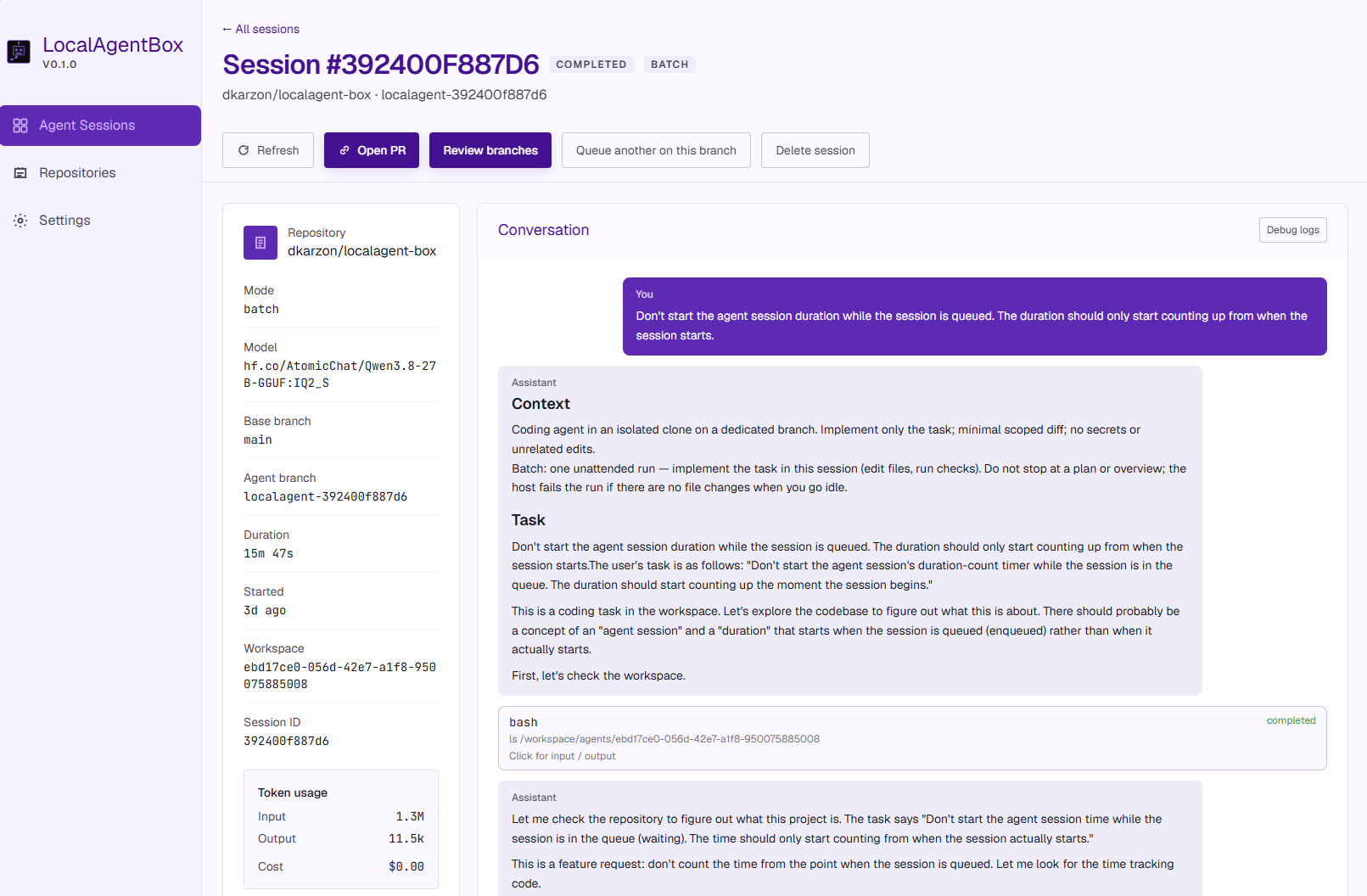
- A single Node process serves the REST/SSE API and the built UI, and persists state (
config.json,repos.json,agents.json) as JSON files underDATA_DIR. - Each agent run is a separate child process (
src/workers/agent-worker.ts) that shallow-clones the target repo into its own workspace, starts a per-agentopencode serveinstance (batch, interactive, and loop modes), or runs Open Code Review (reviewmode), and drives it through one of four flows: batch (single prompt → commit/push), interactive (multi-turn, explicit Finish), loop (config-driven orient/act/reflect harness, seeconfig/loop.default.json), or review (branch-range PR review via OCR → optional GitHub PR comments). - GitHub access goes through a GitHub App installation token minted per-request (
src/services/github-app.ts) — no long-lived PAT or SSH key is stored. - Agent state, logs, and events stream back to the API over the child process's stdout/IPC and are exposed to the UI via Server-Sent Events.
There is no per-agent sandboxing (container, chroot, network namespace) — see SECURITY.md for what that means for your deployment.
Pull the published image from GitHub Container Registry:
docker pull ghcr.io/dkarzon/localagent-box:latestFull run instructions, Compose example, and required environment variables (API_TOKEN, NODE_ENV, OLLAMA_BASE_URL, volumes): docs/docker-hosting.md.
Minimal example:
docker volume create localagent-data
docker volume create localagent-workspace
docker run -d --name localagent-box --restart unless-stopped -p 8080:8080 \
  -e NODE_ENV=production -e API_TOKEN=your-secret-token \
  -e OLLAMA_BASE_URL=http://host.docker.internal:11434 \
  --add-host=host.docker.internal:host-gateway \
  -v localagent-data:/data -v localagent-workspace:/workspace \
ghcr.io/dkarzon/localagent-box:latestdocker compose up -d --buildOpen the management UI at http://localhost:8080. The default API token is localagent-box (pre-filled in the UI) — this is fine for a quick local trial, but set a strong API_TOKEN (and read SECURITY.md) before running this anywhere reachable by anyone you don't trust.
Next steps: set up a GitHub App so agents can clone, commit, and open PRs against your repos.
The repo has two parts: a TypeScript Node.js API in src/ (compiled to dist/) and a React + Vite UI in client/. In production and Docker, the API serves the built UI from public/.
- Node.js ≥ 20
- Git (clone/verify/push)
- Ollama — optional for health checks; required to run agents against a local model
- OpenCode CLI —
npm install -g opencode-ai@v1.18.18(matches the version pinned in the Dockerfile; needed when starting agent jobs locally)
From the repo root:
npm install --ignore-scripts
npm install --prefix client
Use --ignore-scripts on the root install if the postinstall hook loops on your machine; then install the client explicitly as shown.
Build the UI and API, then serve everything from one process:
# Windows (PowerShell)
$env:DATA_DIR="./data"; npm run build:ui && npm run build && npm start

# macOS / Linux
DATA_DIR=./data npm run build:ui && npm run build && npm start
Open http://localhost:8080.
Persisted state (config, repos, agents) is written under ./data/ when DATA_DIR=./data is set. Agent git workspaces use ./data/workspace/agents/ on Windows.
For API-only work with auto-restart on change, use npm run dev instead of npm start (after building the UI once).
To use the prebuilt GHCR image instead of building locally, see docs/docker-hosting.md.
Run once to create the volumes (shared across docker sessions):
docker build --tag 'localagent-box' .Build and run the docker image.
docker volume create localagent-data
docker run -it --rm -p 8080:8080 -v localagent-data:/data 'localagent-box'| Variable | Default (local) | Purpose |
|---|---|---|
PORT |
8080 |
HTTP listen port |
DATA_DIR |
/data |
Config and agent state directory (use ./data locally) |
API_TOKEN |
localagent-box |
Bearer token for mutating API calls |
OLLAMA_BASE_URL |
— | Bootstrap Ollama URL on first start (e.g. http://localhost:11434) |
AGENT_WORKSPACE |
platform-specific | Directory for ephemeral agent clones |
MAX_CONCURRENT_AGENTS |
3 |
Concurrent agent workers |
AGENT_TIMEOUT |
3600 |
Batch worker timeout in seconds, measured from when the worker starts running (not queue wait) |
OCR_REVIEW_TIMEOUT |
30 |
Per-file OCR review deadline in minutes (0 disables). OCR's own default is 10. |
OCR_LLM_TIMEOUT |
600 |
Per-request OCR LLM HTTP timeout in seconds. OCR's own default is 300. |
OCR_REVIEW_CONCURRENCY |
8 |
Max file groups reviewed in parallel. Lower for local LLMs (e.g. Ollama). |
OPENCODE_BIN |
opencode |
OpenCode CLI binary |
OPENCODE_PORT_BASE |
4100 |
Base port for per-agent opencode serve |
OPENCODE_STARTUP_TIMEOUT_MS |
900000 |
Max wait for opencode serve to become ready |
| Command | Description |
|---|---|
npm run dev |
Run API from TypeScript with tsx watch |
npm run dev:ui |
Vite dev server for the React UI |
npm run build |
Compile src/ → dist/ |
npm run build:ui |
Build UI into public/ |
npm start |
Run compiled API (dist/server.js) |
Agents authenticate to GitHub as an installed GitHub App (no PAT or SSH key). See docs/github-app-setup.md for step-by-step instructions: creating the app, scoping permissions (Contents + Pull requests, read/write), installing it on your repos, generating a private key, and wiring the resulting githubAppId / githubAppInstallationId / githubAppPrivateKey into Settings.
localagent-box is built for a trusted local network, not the open internet. Highlights (full detail in SECURITY.md):
- Mutating endpoints require a Bearer token; most
GETendpoints (config, agent logs/transcripts/events, repo metadata) are intentionally unauthenticated so the UI and SSE streams work without embedding a token in every request. - The default
API_TOKEN(localagent-box) is meant for local trials only — always override it before exposing the service beyond your own machine, and setNODE_ENV=productionso the server refuses to boot with the default token. - Agents run as plain child processes with full access to their workspace and the host's network — there is no per-agent sandbox.
- If you must reach this from outside a trusted LAN/VPN, put it behind a reverse proxy with its own TLS + auth; never port-forward it directly.
Read SECURITY.md before deploying anywhere beyond a local trial.
| Symptom | Likely cause / fix |
|---|---|
401 Unauthorized on POST/PUT/DELETE calls |
Missing or wrong Authorization: Bearer <API_TOKEN> header; check the token in Settings or your API_TOKEN env var |
| Server refuses to start in Docker/production | NODE_ENV=production with the default API_TOKEN (localagent-box) still set — pick a real token |
| Health check shows Ollama as unreachable | ollamaBaseUrl isn't reachable from inside the container — on Docker Desktop use http://host.docker.internal:11434, not localhost |
| Agent fails immediately with a GitHub/clone error | GitHub App isn't installed on that repo, or githubAppId/githubAppInstallationId/githubAppPrivateKey are wrong — see docs/github-app-setup.md |
| Agent finishes but no PR appears | push was false, or the OpenCode run didn't produce a commit — batch/loop runs fail if nothing was committed; check GET /agents/:id/logs |
| Review agent fails immediately | Ollama not configured or unreachable — OCR requires ollamaBaseUrl; check Settings and docs/code-review.md |
| Review completes but nothing on GitHub | No PR exists for headBranch, or GitHub App lacks pull request write — check logs for "No matching PR" or GitHub warnings |
npm install hangs or loops |
Use npm install --ignore-scripts at the repo root, then npm install --prefix client separately (see Install dependencies) |
For anything else, check GET /agents/:id/logs and GET /agents/:id/events for the failing session, and SECURITY.md if the question is auth/network-related.
Base URL: http://localhost:8080
Mutating requests require Authorization: Bearer <API_TOKEN>. Default token: localagent-box.
| Method | Path | Auth | Description |
|---|---|---|---|
GET |
/health |
No | Liveness check + Ollama connectivity probe |
GET |
/api/v1/config |
No | Current settings (secrets redacted) |
PUT |
/api/v1/config |
Yes | Update settings and write OpenCode config |
GET |
/api/v1/github/status |
No | GitHub App credential summary (no secrets) |
POST |
/api/v1/github/verify |
Yes | Test shallow clone of { owner, name, branch? } |
GET |
/api/v1/repos |
No | List registered repos |
POST |
/api/v1/repos |
Yes | Register repo { owner, name, defaultBranch } |
GET |
/api/v1/repos/:repoId |
No | Get registered repo metadata |
DELETE |
/api/v1/repos/:repoId |
Yes | Remove registered repo |
PUT |
/api/v1/repos/:repoId |
Yes | Update repo settings (autoReviewPullRequests: true, false, or null to inherit) |
POST |
/api/v1/repos/:repoId/verify |
Yes | Test shallow clone for registered repo |
GET |
/api/v1/agents |
No | List agents (?repoId=, ?status= filters) |
POST |
/api/v1/agents |
Yes | Start repo-scoped agent |
GET |
/api/v1/agents/:agentId |
No | Agent status |
GET |
/api/v1/agents/:agentId/logs |
No | Agent log tail (?tail=200, default 200) |
GET |
/api/v1/agents/:agentId/events |
No | SSE stream of agent events (?since= or Last-Event-ID) |
GET |
/api/v1/agents/:agentId/messages |
No | Transcript + events snapshot (?since= for event replay) |
POST |
/api/v1/agents/:agentId/messages |
Yes | Send follow-up message (interactive only) |
POST |
/api/v1/agents/:agentId/finish |
Yes | Finish interactive or loop session + commit/push |
POST |
/api/v1/agents/:agentId/retry |
Yes | Re-queue a failed or cancelled session in the same slot |
POST |
/api/v1/agents/:agentId/allow-successors |
Yes | Let later sessions on the same branch start after a failed/cancelled chunk |
POST |
/api/v1/agents/:agentId/pull-request |
Yes | Open GitHub PR for completed, pushed session |
GET |
/api/v1/agents/:agentId/pull-request |
No | Refresh linked PR state from GitHub |
POST |
/api/v1/agents/:agentId/delete |
Yes | Remove agent record, logs, and workspace |
DELETE |
/api/v1/agents/:agentId |
Yes | Cancel a running or queued agent |
| Field | Description |
|---|---|
ollamaBaseUrl |
External self-hosted Ollama URL |
opencodeModel |
Model name on Ollama |
opencodeProvider |
Provider id (default ollama) |
systemPrompt |
Default system prompt for agents (empty string stored as null in GET) |
githubAppId |
GitHub App ID |
githubAppInstallationId |
Installation ID |
githubAppPrivateKey |
PEM private key (sent as *** in GET; omit or send *** on PUT to keep existing key) |
gitUserName |
Commit author name |
gitUserEmail |
Commit author email |
webhookUrl |
Optional HTTP(S) URL; POST JSON on terminal agent status (agent.completed, agent.failed, agent.cancelled) |
batchAutoApprovePermissions |
When true (default), batch agents auto-approve OpenCode tool permissions via per-agent opencode.json |
loopAutoApprovePermissions |
When true (default), loop agents auto-approve tool permissions |
interactiveAutoApprovePermissions |
When true, interactive agents auto-approve tool permissions (default false) |
interactiveAgentTimeoutSeconds |
Interactive session timeout in seconds from worker start (default 3600; separate from AGENT_TIMEOUT for batch workers) |
loopAgentTimeoutSeconds |
Loop session timeout in seconds from worker start (default 3600; separate from AGENT_TIMEOUT for batch workers) |
loopVerbModels |
Per-verb model overrides for loop mode (INITIAL_PLAN, ORIENT, ACT, REFLECT). Empty string on a verb uses the fallback chain below. Legacy OBSERVE/PLAN keys are accepted and folded into ORIENT. |
autoCreatePullRequest |
When true (default), automatically open a draft PR once an agent completes and pushes its branch. A per-agent autoCreatePullRequest on create overrides this. |
autoReviewPullRequests |
When true, auto-queue a review agent after a coding agent's PR is created (default false). Per-repo autoReviewPullRequests overrides this global default. See docs/code-review.md. |
reviewModel |
Model used for auto-queued and manual review agents (Open Code Review); falls back to opencodeModel when empty |
All fields above are readable via GET /api/v1/config and settable via PUT /api/v1/config, and every one of them is editable from the Settings page in the UI (API Access, Ollama Status, GitHub Integration, Webhooks, OpenCode, Pull requests & review, and OpenCode permissions cards). Batch, loop, and interactive agents all run through opencode serve with per-agent isolated config at {dataDir}/agents/{agentId}/opencode-config/opencode.json. Per-agent autoApprovePermissions on create overrides the mode default from Settings.
When a loop step runs, the model is chosen in this order:
loopVerbModels[verb]— Settings value for that step (e.g.ACT), when non-emptymodelon agent create — per-agent override from the create formopencodeModel— global default from Settings- OpenCode default — when nothing above is set
Step prompts stay in config/loop.default.json or repo .localagent-box/loop.json; verb models are a server-wide operator setting (same pattern as loopAutoApprovePermissions).
Example — global default llama3.2, ACT on a coder model, others blank:
{
  "opencodeModel": "llama3.2",
  "loopVerbModels": {
    "INITIAL_PLAN": "",
    "ORIENT": "",
    "ACT": "qwen3-coder:30b",
    "REFLECT": ""
  }
}
ORIENT, REFLECT, and INITIAL_PLAN use llama3.2; ACT uses qwen3-coder:30b.
curl http://localhost:8080/health

curl http://localhost:8080/api/v1/config

curl -X PUT http://localhost:8080/api/v1/config \
  -H "Authorization: Bearer localagent-box" \
  -H "Content-Type: application/json" \
  -d '{"ollamaBaseUrl":"http://host.docker.internal:11434","opencodeModel":"llama3.2"}'
Saving Ollama settings writes OpenCode config to ~/.config/opencode/opencode.json inside the container. The health endpoint probes {ollamaBaseUrl}/api/tags.
Optional bootstrap env vars: OLLAMA_BASE_URL, OPENCODE_MODEL, OPENCODE_PROVIDER.
curl http://localhost:8080/api/v1/github/status

curl -X POST http://localhost:8080/api/v1/github/verify \
  -H "Authorization: Bearer localagent-box" \
  -H "Content-Type: application/json" \
  -d '{"owner":"your-org","name":"your-private-repo","branch":"main"}'
Installation tokens are minted server-side and never returned by the API. Clone URLs with embedded tokens are redacted from error messages.
curl http://localhost:8080/api/v1/repos

curl -X POST http://localhost:8080/api/v1/repos \
  -H "Authorization: Bearer localagent-box" \
  -H "Content-Type: application/json" \
  -d '{"owner":"your-org","name":"your-repo","defaultBranch":"main"}'

curl -X POST http://localhost:8080/api/v1/repos/your-org-your-repo/verify \
  -H "Authorization: Bearer localagent-box" \
  -H "Content-Type: application/json" \
  -d '{}'
Repo metadata is persisted in DATA_DIR/repos.json. Clones happen in ephemeral workspaces at verify/agent time, not at registration.
Agents support four modes:
| Mode | Behavior |
|---|---|
batch (default) |
Single prompt → opencode serve (session orchestrator) → auto commit/push → terminal status. Best for API, CI, and one-shot UI runs. |
interactive |
Multi-turn session on the same OpenCode server. Follow-up messages when status is awaiting_input; call Finish to commit/push. |
loop |
Config-driven harness: observe → plan → act → reflect cycles until the model emits LOOP_COMPLETE: true on REFLECT or host caps are hit. Create-time prompt is the goal; step prompts come from loop.json. Optional per-verb models in Settings (loopVerbModels). Single commit/push at end (or early Finish). |
review |
Branch-range PR review via Open Code Review (ocr review). Clones and checks out headBranch, diffs against baseBranch, posts findings to GitHub when a matching PR exists. No OpenCode session; no commit/push. See docs/code-review.md. |
Omit mode or set "mode": "batch" for the existing headless behavior.
curl http://localhost:8080/api/v1/agents
curl "http://localhost:8080/api/v1/agents?repoId=your-org-your-repo&status=running"

# Batch (default)
curl -X POST http://localhost:8080/api/v1/agents \
  -H "Authorization: Bearer localagent-box" \
  -H "Content-Type: application/json" \
  -d '{
    "repoId": "your-org-your-repo",
    "prompt": "Add input validation to the login form",
    "systemPrompt": "You are a careful code reviewer.",
    "baseBranch": "main",
    "agentBranch": "agent/task-42",
    "commitMessage": "Agent: add login validation",
    "push": true,
    "model": "llama3.2"
  }'

# Interactive — multi-turn session
curl -X POST http://localhost:8080/api/v1/agents \
  -H "Authorization: Bearer localagent-box" \
  -H "Content-Type: application/json" \
  -d '{
    "repoId": "your-org-your-repo",
    "mode": "interactive",
    "prompt": "Explore the auth module and suggest fixes",
    "baseBranch": "main",
    "agentBranch": "agent/interactive-1",
    "autoApprovePermissions": false,
    "push": true
  }'

# Loop — config-driven harness toward a goal
curl -X POST http://localhost:8080/api/v1/agents \
  -H "Authorization: Bearer localagent-box" \
  -H "Content-Type: application/json" \
  -d '{
    "repoId": "your-org-your-repo",
    "mode": "loop",
    "prompt": "Add input validation to the login form with tests",
    "baseBranch": "main",
    "agentBranch": "agent/loop-validation",
    "push": true
  }'

# Review — Open Code Review on a branch range (posts to GitHub PR when one exists)
curl -X POST http://localhost:8080/api/v1/agents \
  -H "Authorization: Bearer localagent-box" \
  -H "Content-Type: application/json" \
  -d '{
    "repoId": "your-org-your-repo",
    "mode": "review",
    "baseBranch": "main",
    "headBranch": "agent/task-42",
    "background": "Focus on security and edge cases."
  }'

curl http://localhost:8080/api/v1/agents/<agentId>

curl "http://localhost:8080/api/v1/agents/<agentId>/logs?tail=100"

# SSE + transcript (both modes; replay with ?since=<seq>)
curl -N "http://localhost:8080/api/v1/agents/<agentId>/events?since=0"
curl "http://localhost:8080/api/v1/agents/<agentId>/messages?since=0"

# Interactive only (409 NOT_INTERACTIVE on batch and loop)
curl -X POST http://localhost:8080/api/v1/agents/<agentId>/messages \
  -H "Authorization: Bearer localagent-box" \
  -H "Content-Type: application/json" \
  -d '{"text":"Also add tests for the login form"}'

# Interactive or loop — early finish + commit/push
curl -X POST http://localhost:8080/api/v1/agents/<agentId>/finish \
  -H "Authorization: Bearer localagent-box"

# GitHub PR after successful batch finish or interactive Finish (requires push)
curl -X POST http://localhost:8080/api/v1/agents/<agentId>/pull-request \
  -H "Authorization: Bearer localagent-box" \
  -H "Content-Type: application/json" \
  -d '{"title":"Agent: add login validation","body":"Optional PR body"}'
curl http://localhost:8080/api/v1/agents/<agentId>/pull-request

curl -X DELETE http://localhost:8080/api/v1/agents/<agentId> \
  -H "Authorization: Bearer localagent-box"

curl -X POST http://localhost:8080/api/v1/agents/<agentId>/delete \
  -H "Authorization: Bearer localagent-box"
Each agent gets an isolated git workspace under AGENT_WORKSPACE (default {DATA_DIR}/workspace/agents/<workspaceId>/ on Windows, /workspace/agents/<workspaceId>/ in Docker). Agent metadata, logs, events, and per-agent OpenCode config live under {DATA_DIR}/agents/{agentId}/. Batch, interactive, and loop modes use opencode serve with the session orchestrator; interactive workers poll an inbox for follow-ups until Finish; loop workers drive multi-step harness cycles from config; review workers run Open Code Review instead of OpenCode. Multiple sessions may share an agentBranch; at most one worker runs per (repoId, agentBranch) and a later session starts only after the previous one on that branch completed and pushed.
Loop mode uses a server default at config/loop.default.json. A repo can fully replace it with .localagent-box/loop.json in the cloned workspace (no partial merge in v1).
{
  "version": 1,
  "maxIterations": 10,
  "completionMarker": "LOOP_COMPLETE",
  "initialPlanPrompt": "Create a high-level plan for the goal before iterative cycles begin.\n\nGoal: {{goal}}",
  "steps": [
    { "verb": "ORIENT", "prompt": "Inspect the relevant code and state the smallest next change…\n\nGoal: {{goal}}\nIteration: {{iteration}}" },
    { "verb": "ACT", "prompt": "Implement the change…\n\nGoal: {{goal}}\nIteration: {{iteration}}" },
    { "verb": "REFLECT", "prompt": "If done, output: {{completionMarker}}: true\n\nGoal: {{goal}}\nIteration: {{iteration}}" }
  ]
}
Valid step verbs are ORIENT, ACT, and REFLECT (legacy OBSERVE/PLAN are accepted and normalized to ORIENT). Template variables: {{goal}} (create-time prompt), {{iteration}} (1-based macro-iteration; 0 during optional initialPlanPrompt), {{completionMarker}}. Optional initialPlanPrompt runs once before the first iteration to produce a high-level plan for the goal. The model must emit a line matching LOOP_COMPLETE: true (or your custom marker) on REFLECT to signal completion. Loop runs fail if no file changes are committed at end (same as batch).
| Field | Description |
|---|---|
repoId |
Registered repo id (required) |
prompt |
User task prompt (required); for loop mode this is the goal |
agentBranch |
Branch to create and work on (optional; defaults to localagent-{sessionId} using the new agent id). Ignored when useExistingBranch is true. |
useExistingBranch |
When true, shallow-clone and check out baseBranch on the remote instead of creating a new agentBranch (default false) |
mode |
batch (default), interactive, loop, or review |
baseBranch |
Base to clone (default: repo defaultBranch or main); for review, the diff from branch |
headBranch |
Review mode only — branch to check out and review (diff to branch); required for review |
background |
Review mode only — optional context passed to Open Code Review |
parentAgentId |
Review mode only — link to a parent coding session (auto-spawn sets this) |
systemPrompt |
Optional per-agent system prompt |
commitMessage |
Git commit message (default Agent: <agentBranch>; used on Finish for interactive) |
push |
Push branch after commit (default true) |
pushOnFailure |
Commit/push even when OpenCode fails (default false; batch only) |
model |
Override opencodeModel for this agent only |
autoApprovePermissions |
Override Settings auto-approve for OpenCode tool permissions |
autoCreatePullRequest |
Override the Settings autoCreatePullRequest default for this agent only |
Statuses include queued, running, awaiting_input, processing, completing, completed, failed, and cancelled. Interactive agents move through awaiting_input between turns; batch agents typically go queued → running → completed or failed; loop agents stay in processing between harness steps (no awaiting_input); review agents stay in processing while OCR runs (no awaiting_input or Finish). GET /agents and GET /agents/:id include a derived queue object with wait reason, predecessor, and canRetry / canAllowSuccessors for shared-branch chains. The sessions list and session page show that wait reason; a failed or cancelled chunk can Retry in place or Start next queued, and Queue another on this branch prefills a new session on the same head. Completed coding sessions with a pushed branch expose Review branches when review is allowed.
SSE event types: session.status, assistant.delta, assistant.message, tool.start, tool.end, permission.requested, error, log.line, plus loop events loop.step.start, loop.step.end, and loop.iteration.end. The stream closes ~1.5s after a terminal status.
Loop agents expose agent.loop on GET /agents/:id with fields such as iteration, stepIndex, currentVerb, maxIterations, canFinish, and finishRequested.
GET /messages returns { agentId, messages, lastEventSeq, events }. For batch agents with no conversation file yet, messages contains the initial user prompt.
When webhookUrl is set, the server POSTs JSON to that URL when an agent reaches a terminal status. Payload shape: { event, agent, timestamp } where event is agent.completed, agent.failed, or agent.cancelled.
POST .../pull-request requires status: completed, OpenCode success, pushed: true, and no existing pullRequest on the agent (409 PR_NOT_READY or PR_EXISTS otherwise). When Ollama is configured, title and body are generated by the local LLM from the task, agent summary, commit message, and git diff; otherwise they default from the commit message, prompt, and branch metadata. GET .../pull-request refreshes state, mergedAt, and related fields from GitHub (404 PR_NOT_FOUND if none linked).
Environment: MAX_CONCURRENT_AGENTS (default 3), AGENT_TIMEOUT seconds for batch workers (default 3600), OPENCODE_BIN (default opencode), OPENCODE_PORT_BASE (default 4100), OPENCODE_STARTUP_TIMEOUT_MS (default 900000). Remove finished sessions with POST /api/v1/agents/<agentId>/delete (or the UI) to delete logs, events, and workspace data.