







Eliminate 1D, 2D or 3D points: weighted sample elimination to an exact count with progressive ordering, and greedy elimination by minimum distance, both with adaptive spacing.
eliminateToCount implements weighted sample elimination, progressive sampling and adaptive sampling from:
Cem Yuksel. Sample Elimination for Generating Poisson Disk Sample Sets. Computer Graphics Forum (Proceedings of EUROGRAPHICS 2015), 34(2), 25–32, 2015. doi:10.1111/cgf.12538
Reference implementation: cyCodeBase





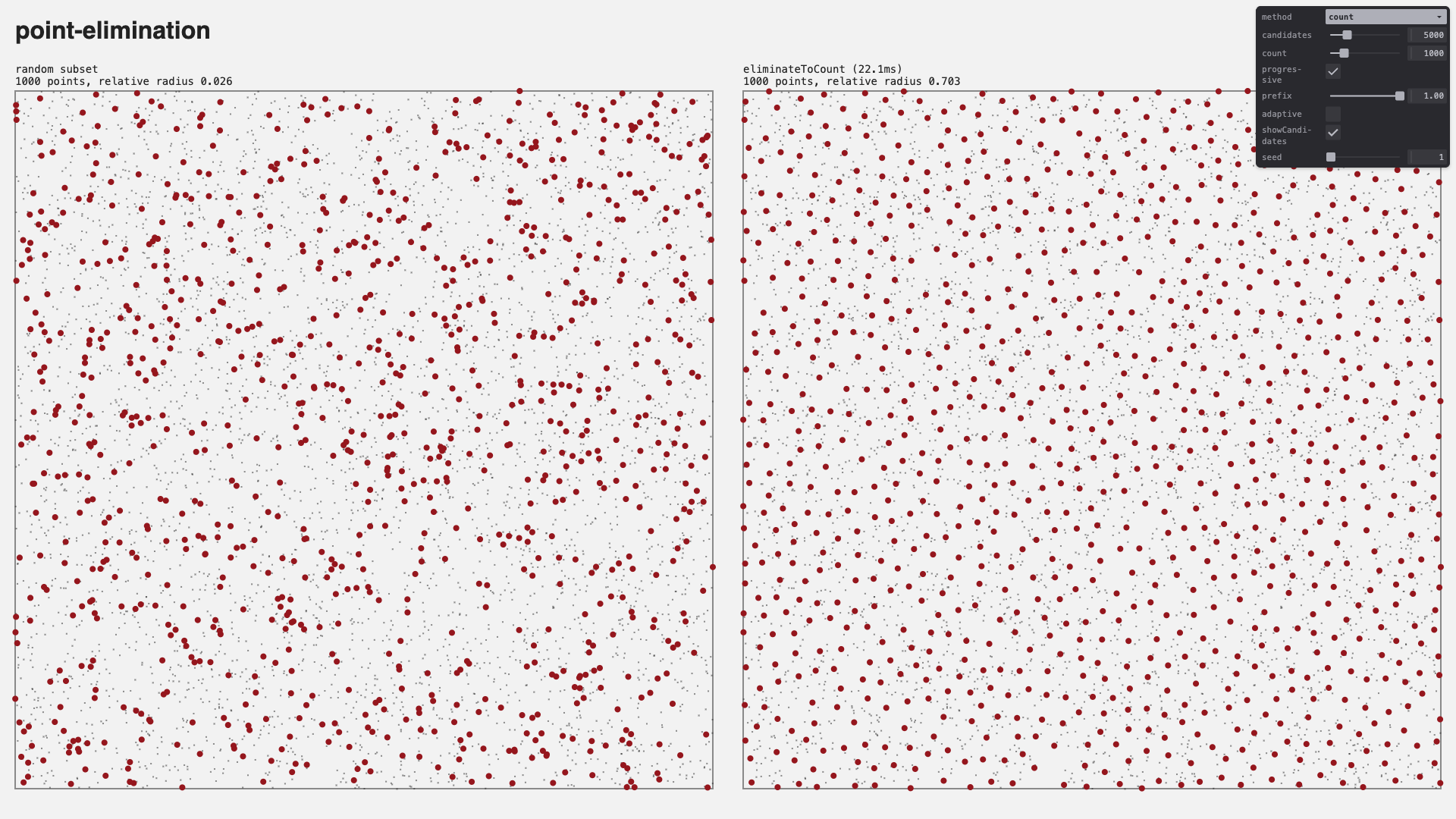
npm install point-eliminationSee the example and its source.
import {
  eliminateToCount,
  eliminateByDistance,
  packingRadius,
} from "point-elimination";

// 5000 random 2D points
const points = Float32Array.from({ length: 5000 * 2 }, Math.random);

// Poisson disk subset of exactly 1000 points
const indices = eliminateToCount(points, 1000, { dimension: 2 });
// => Uint32Array of kept point indices

// Progressive ordering: the first k indices are also well distributed, for any
// k. Slice the output to change the density without eliminating again.
const ordered = eliminateToCount(points, 1000, {
  dimension: 2,
  progressive: true,
});
const first100 = ordered.subarray(0, 100);

// The domain defaults to the bounding box (its volume for 3D points). Set it
// when points don't fill their bounding box, eg. the area of a mesh surface.
const surfaceIndices = eliminateToCount(meshPoints, 1000, {
  domainSize: meshArea,
  domainDimension: 2,
});

// Points at least 0.02 apart, earlier points first
const spaced = eliminateByDistance(points, 0.02, { dimension: 2 });

// Adaptive spacing: twice the distance where scale is 2
const scales = Float32Array.from({ length: 5000 }, (_, i) =>
  points[i * 2] < 0.5 ? 1 : 2,
);
const adaptive = eliminateByDistance(points, 0.02, { dimension: 2, scales });

// Poisson disk radius of 1000 points densely packed in a unit square: their
// minimum distance is twice that
const radius = packingRadius(1, 1000, 2);- pointElimination
- static
- .eliminateByDistance(points, distance, [options]) ⇒
Uint32Array - .eliminateToCount(points, count, [options]) ⇒
Uint32Array - .packingRadius(domainSize, count, [domainDimension]) ⇒
number
- .eliminateByDistance(points, distance, [options]) ⇒
- inner
- ~EliminateByDistanceOptions :
object - ~EliminateToCountOptions :
object
- ~EliminateByDistanceOptions :
- static
Greedy elimination: keeps each point, in order, not closer than distance to
an already kept one. Every removed point of order conflicts with a kept
point.
Kind: static method of pointElimination
Returns: Uint32Array - Unique indices of the kept points, in visiting order.
| Param | Type | Default | Description |
|---|---|---|---|
| points | ArrayLike.<number> |
Flat array of point components. | |
| distance | number |
Minimum distance between kept points. | |
| [options] | EliminateByDistanceOptions |
{} |
Weighted sample elimination (Yuksel
2015) to a Poisson
disk distributed subset of count points.
Use 3 to 5 times more input points than count: more barely improves quality
while cost grows quadratically.
Kind: static method of pointElimination
Returns: Uint32Array - Indices of the kept points, ascending unless
progressive.
| Param | Type | Default | Description |
|---|---|---|---|
| points | ArrayLike.<number> |
Flat array of point components. | |
| count | number |
||
| [options] | EliminateToCountOptions |
{} |
Poisson disk radius of count points densely packed in a domain of
domainSize: segments in 1D, hexagonal in 2D and face-centered cubic in 3D.
Points are twice that apart.
Kind: static method of pointElimination
| Param | Type | Default | Description |
|---|---|---|---|
| domainSize | number |
Length, area or volume of the domain. | |
| count | number |
||
| [domainDimension] | number |
3 |
From 1 to 3. |
Kind: inner typedef of pointElimination
Properties
| Name | Type | Default | Description |
|---|---|---|---|
| [dimension] | number |
3 |
Number of components per point, from 1 to 3. |
| [scales] | ArrayLike.<number> |
Per point distance multiplier, positive and finite: two points conflict below distance times the mean of their scales. |
|
| [order] | ArrayLike.<number> |
Indices in visiting order: earlier points have priority. Points not listed are discarded. Defaults to the index order. |
Kind: inner typedef of pointElimination
Properties
| Name | Type | Default | Description |
|---|---|---|---|
| [dimension] | number |
3 |
Number of components per point, from 1 to 3. |
| [domainSize] | number |
Length, area or volume of the sampled domain. Defaults to the points bounding box, ignoring flat axes. Set it for points on a curve or surface, eg. the area of a mesh. | |
| [domainDimension] | number |
Dimension of the sampled domain, from 1 to 3, eg. 2 for a surface in 3D. Defaults to the bounding box dimension, or dimension when domainSize is set. Set with domainSize. |
|
| [scales] | ArrayLike.<number> |
Per point spacing multiplier for adaptive sampling, positive and finite. Normalize them so that the domain mean of 1 / scale^domainDimension is 1. | |
| [weightLimiting] | boolean |
true |
Cap the weight of very close neighbors. |
| [progressive] | boolean |
false |
Order the output so that each prefix is itself well distributed. |
MIT. See license file.