
Copilot-style prompt autosuggestions for the OpenCode TUI.
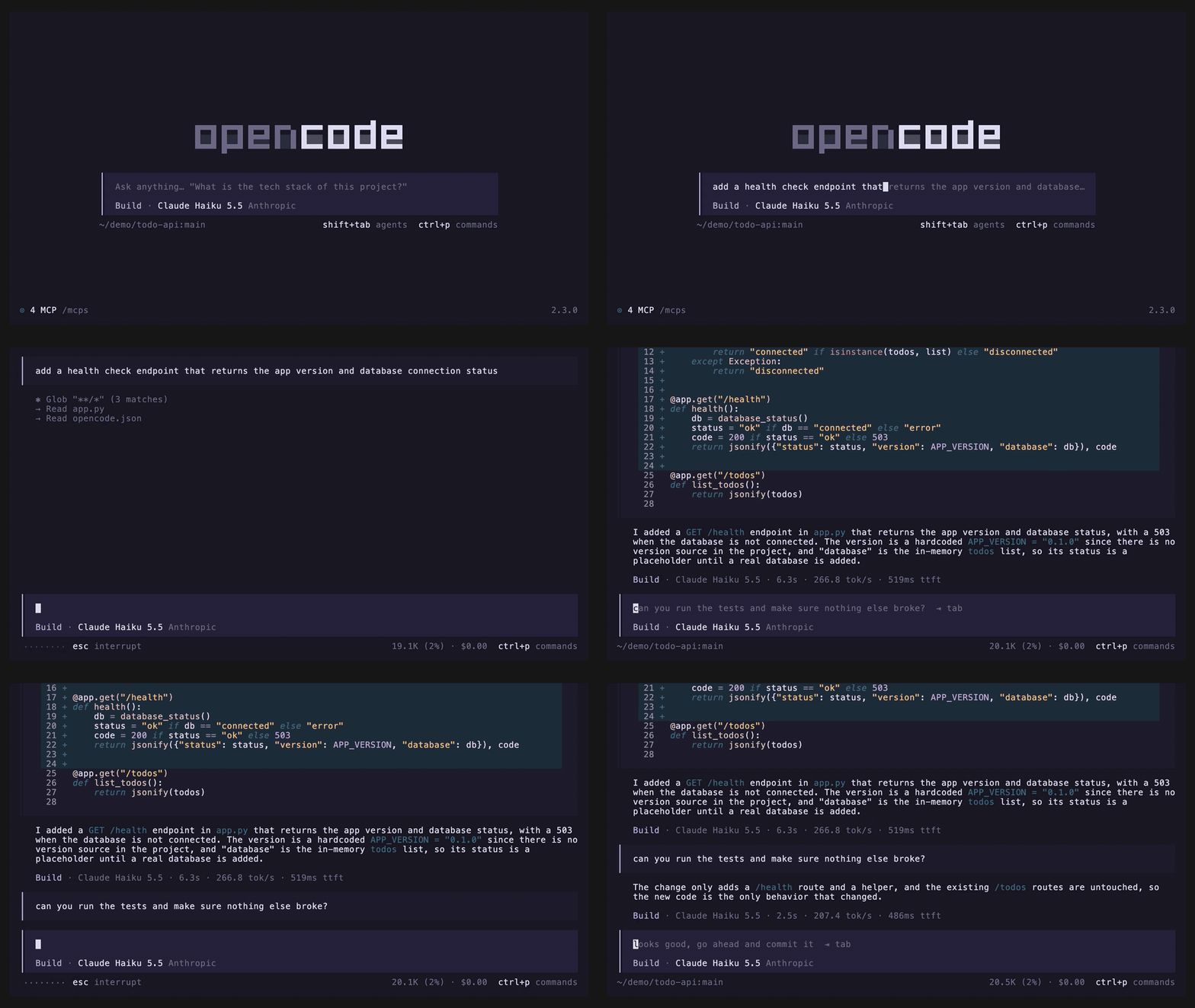
- Follow-ups: when a turn finishes, a cheap model reads the last few messages and suggests what you will probably type next, as ghost text in the empty prompt.
- Autocomplete: pause while typing and it suggests how to finish your message, right after the cursor.
Tab accepts, Option+→ (Alt+→, Alt+F) or Ctrl+→ accepts the next word, like fish, Esc dismisses, and typing keeps going as usual. Enter only ever sends what you typed.
Terminals and multiplexers often take these keys first. On macOS, Ctrl+→ switches desktops unless that Mission
Control shortcut is off, and Ghostty sends Option+→ as Alt+F. If none of them reaches OpenCode, pick another key with
acceptWordKey.
Follow-ups only appear after a turn that ended normally: not after an error, and not while a queued prompt, permission request, or question is waiting for you.
Suggestions follow your language and tone: they are written the way you write in the conversation, and completions continue whatever you are typing.
Built and tested with OpenCode 2.3. It is a TUI-only plugin, so add it to ~/.config/opencode/cli.json (not
opencode.json):
{
  "plugins": ["opencode-autosuggestions"]
}By default the plugin picks a model on its own (Auto), using only the provider of your current session, so it never calls an account you are not already using:
- The cheapest priced model from that provider (for Anthropic, Claude Haiku).
- Otherwise a model whose name says it is small (
mini,nano,flash,haiku,lite, ...). - Otherwise the session's own model.
It asks for the lowest reasoning level first and falls back when an account does not allow it, remembering what failed.
To pick a model yourself, press Ctrl+P and run Choose suggestion model. The choice is saved across restarts.
All under "Autosuggestions" in the command palette (Ctrl+P):
| Command | What it does |
|---|---|
| Choose suggestion model | Auto, or any model you have |
| Toggle autosuggestions | Turns the plugin on or off |
| Toggle follow-up suggestions | Turns only the suggestion after each turn on or off |
| Toggle autocomplete | Turns only the completions while typing on or off |
| Suggest follow-up now | Generates a follow-up now, even when automatic follow-ups are off |
| Show suggestion usage | Calls, tokens, and estimated cost: today, last 7 days, and in total |
Pass options with the object form in cli.json:
{
  "plugins": [
    {
      "package": "opencode-autosuggestions",
      "options": {
        "model": "openai/gpt-6-luna",
        "autocompleteDelay": 800
      }
    }
  ]
}| Option | Default | Description |
|---|---|---|
enabled |
true |
false disables the plugin entirely |
model |
"auto" |
provider/model, optionally #variant (e.g. openai/gpt-6-luna#low) |
followUps |
true |
Suggest the next prompt after each turn |
autocomplete |
true |
Completions while typing |
autocompleteDelay |
600 |
Milliseconds of pause before asking for a completion |
acceptKey |
"tab" |
Key that accepts a suggestion |
acceptWordKey |
"alt+right,alt+f,ctrl+right" |
Keys that accept the next word of a suggestion, separated by commas |
dismissKey |
"escape" |
Key that dismisses a suggestion |
maxMessages |
8 |
Recent messages sent as context for follow-up suggestions |
maxChars |
6000 |
Character cap for that context |
debug |
false |
Writes failed suggestion calls to opencode-autosuggestions.log in the system temp directory |
A model picked from the palette overrides the model option. Setting followUps or autocomplete to false in
cli.json turns that feature off regardless of the palette toggles.
Each suggestion is one short model call: one per finished turn, and one per pause while typing. A call is cancelled as
soon as its result is no longer needed, for example when you keep typing or send a new prompt. To make fewer calls,
turn either one off with "followUps": false or "autocomplete": false, or from the command palette.
Show suggestion usage in the command palette shows how many calls the plugin made, their tokens, and their cost, for today, the last 7 days, and in total, per model. OpenCode does not report token counts for these calls, so they are estimated from text length (about 4 characters per token) and priced at the model's list price. Subscriptions have no price, so only calls and tokens are shown for them. Cancelled calls count the prompt they sent. The last 90 days are kept.
OpenCode's plugin API has no way to read or draw inside the prompt, so the plugin reads the prompt through the renderer's focused editor and draws suggestions as a layer positioned at the cursor. These are OpenCode internals, not public API, so an OpenCode update can break the plugin. When that happens, suggestions stop showing; the prompt keeps working.
bun install
bun run check   # types, lint, and tests
bun run build
The code that depends on OpenCode internals is in src/host.ts; the rest is plain logic with tests in test/.
eval/ runs a set of English and Spanish conversations through the prompts, so prompt changes can be compared
instead of guessed. It calls models through your local OpenCode service, so it uses your configured providers:
bun run eval before --samples 2   # save a run with the current prompts
# change src/prompts.ts
bun run eval after --samples 2
bun run eval:compare before after # summary, and every suggestion side by side
Results go to eval/results/, which is not committed.
- Bump
versioninpackage.jsonand add its section toCHANGELOG.md. - Commit, then push a matching tag:
git tag v0.1.5 && git push origin v0.1.5.
The release workflow runs the checks, publishes to npm, and creates the GitHub release with the CHANGELOG section as notes.
Point cli.json at your checkout to try it:
{
  "plugins": ["/path/to/opencode-autosuggestions"]
}
Rebuild after changes; OpenCode reloads the plugin on its own.
MIT