

Garmin filters the FIT files it sends to Intervals.icu. This puts the data back — and syncs a lot more.
Set up in five minutes: Windows · Mac · Synology · Unraid · Home Assistant · Linux & Docker
- Your Garmin metrics back on every activity — Stamina, Recovery Time, VO₂max, Performance Condition, Training Effect, Sweat Loss … from the original file, nothing duplicated, training load untouched.
- The wellness the official sync misses — night SpO₂, respiration, HRV details, sleep stages, Body Battery, stress, readiness, logged nutrition, endurance & hill scores, race predictions … and the past, backfilled.
- And more — your Garmin gear (bikes, shoes, skis) on the activities, ImReady4's daily training advice, 20 ready-made charts, a web page, a note or push message when it needs you. It runs quietly in the background on your own computer, NAS or server.
- Not on Intervals? Backup mode keeps all your Garmin data – original activity files, every day's wellness, the watch's own files – in a folder of yours.
Why: since late September 2026 Garmin strips its own metrics from the FIT files it hands to partners. The bridge fetches the original from Garmin Connect, with your own login, and completes the activity the official sync created — or, in swap mode, puts the original file into it.

An officially imported run after the bridge: Training Effect, VO₂max, Performance Condition, Recovery Time, Stamina at start/end, Sweat Loss — all stripped by Garmin, all back.

A custom stream (grade-adjusted speed) written into the same activity, aligned by timestamp.
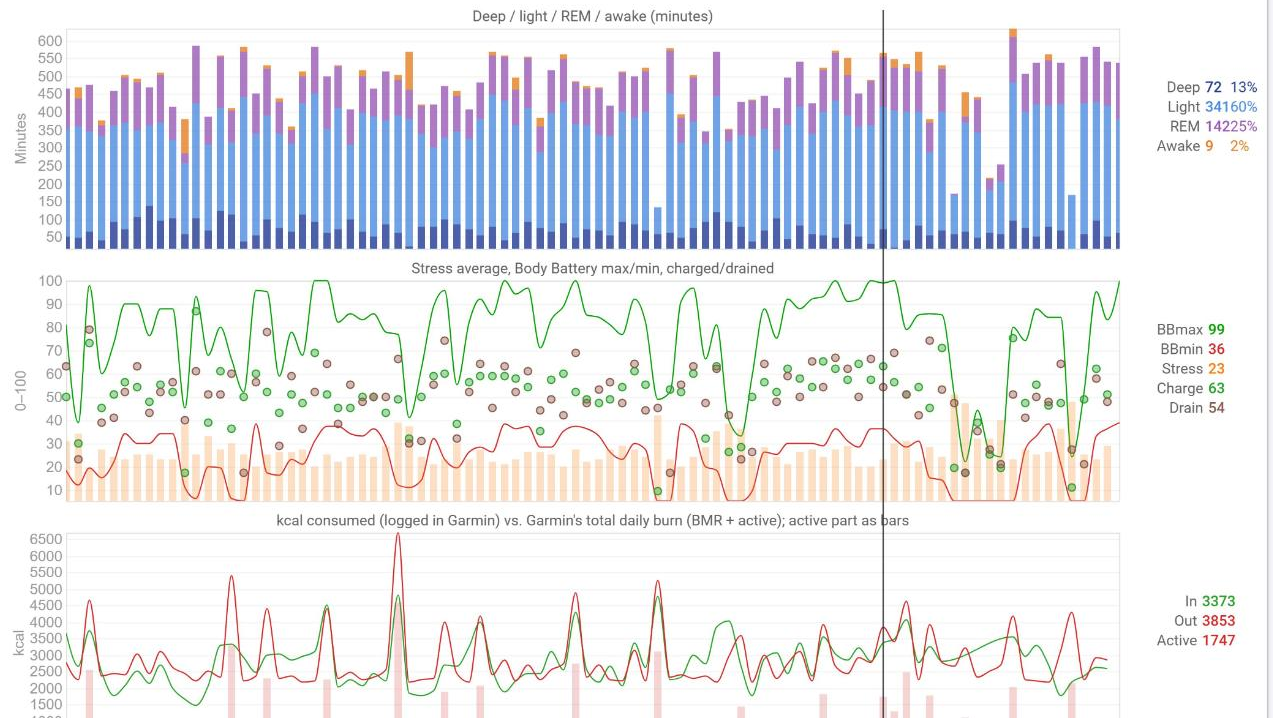
Three of the twenty charts from the chart library: sleep stages, stress & Body Battery, intake vs. total burn.
Since the end of September 2026 the file Garmin hands to partners is not the file your device recorded. (Garmin first switched the filter on in March 2026, rolled it back after a week of protest, and switched it back on half a year later.) The recording survives (power, heart rate, GPS, cadence, developer fields); Garmin's own metrics do not. Open the same activity in Intervals.icu and in Garmin Connect and you will miss Performance Condition, Stamina, Recovery Time, VO₂max, Training Effect and Sweat Loss. The original file you can download from Garmin Connect still has them.
This bridge is a small self-hosted service that:
- fetches the original FIT through Garmin Connect's private API, byte-identical to the browser export;
- finds the activity the official sync already created in Intervals.icu — the sync stays on, nothing is duplicated, deleted or recomputed;
- adds exactly what Garmin stripped, into the custom fields and streams you have configured (Stamina curve, Recovery Time, VO₂max, Performance Condition, Sweat Loss, Training Effect …);
- fills the daily wellness values the official sync does not deliver: night SpO₂, respiration, sleeping heart rate, Body Battery, HRV details, sleep stages, stress, readiness, floors, scale data — and your logged nutrition (kcal, carbs, protein, fat);
- can backfill the past (on the reference account SpO₂ had silently stopped arriving in mid-2025);
- reacts within minutes of the official import (it asks Intervals every 5 minutes – or, adaptive, mostly around the hours you usually finish an activity), with Garmin contacted only when there is something new.
Everything is a dry run until you say --apply. Values that exist are never
overwritten unless they demonstrably came from a filtered file.
Sister project: the Futureweb Intervals MCP
lets ChatGPT, Claude and any other MCP client read and analyse everything the bridge writes:
every custom activity field and stream, every native and Garmin… wellness field, with the
names and units of your own definitions. Install with uvx futureweb-intervals-mcp@1.0.0b1,
from Docker Hub or as a Claude Desktop bundle; more below.
| Activities (enrich mode) | Daily wellness | |
|---|---|---|
| Source | Original FIT from Garmin Connect | Garmin's daily endpoints (up to 30 of them) |
| Target | Your Intervals custom activity fields and custom streams, defined by you, read from your own definitions | Native Intervals wellness fields first, private Garmin… custom fields for the rest |
| Examples | Stamina / Potential Stamina streams, Recovery Time, VO₂max, Performance Condition, Sweat Loss, Aerobic/Anaerobic Effect, Stamina at start/end, EPOC, Training Load, grade-adjusted speed | SpO₂, respiration, sleeping HR, resting HR, HRV (+5-min high, 7-day avg), sleep seconds/score/stages, Body Battery max/min/charged/drained, training readiness, recovery time, acute load, stress, intensity minutes, floors, steps, hydration, sweat loss, weight, body fat, kcal consumed, total and active burn, carbohydrates, protein, fat (g and kcal), endurance & hill scores, fitness age, race predictions, VO₂max (run/bike) |
| Rule | Only what the partner copy lacks; aligned by timestamp; idempotent | Only empty values; locked days skipped; today's running totals wait until tomorrow |
| Archive | Original + partner copy of every activity, Garmin's summary, weather, gear, splits | Raw JSON of every endpoint and the watch's original wellness files (Health Snapshots included), every day |
Version 0.11.3. Verified end to end on one account (fenix 8, Edge 1040); what changed when is in the CHANGELOG, where it goes next in the roadmap.
- Original FIT.
garminconnectdownloads the activity's original export; the ZIP is unpacked in memory, the FIT is CRC-checked with Garmin's official FIT SDK and archived unchanged. - Match. The Intervals activity is found by
external_id(the official sync stores the Garmin activity ID) or, failing that, by source, start time (±120 s) and duration (±5 %). Anything ambiguous is left alone. - Gap. The file Intervals received (
GET /activity/{id}/file) is decoded next to the original. What only the original carries is the gap: whole message types, record fields (stream candidates), session fields (scalar candidates), developer fields, and Garmin-internal numeric IDs. - Write back. Your own custom items say what to write and from where.
Intervals fills custom activity fields and custom streams from the FIT
itself, and every definition names its source (
fit_session_field: "140.9",fit_record_field: "stance_time", or a one-line script readingm.f_138), plus an optional first-import conversion. The bridge reuses those definitions verbatim: same fields, same source, same units, nothing Garmin-specific hard-coded. Scalars go throughPUT /activity/{id}, streams throughPUT /activity/{id}/streams, aligned to the activity'stimestream by timestamp. - Never overwrite real data. An existing value is replaced only when
its FIT source is present in the original and absent from the partner
copy; then it cannot have come from data (Intervals stores
0for a stripped source). A second run writes nothing.
Garmin does not filter every activity. The gap is measured per activity and never assumed.
On your own computer (Windows, Mac, Linux desktop), Python 3.12 or newer:
pip install garmin-intervals-bridge          # Windows: py -m pip install garmin-intervals-bridge
garmin-intervals-bridge setup                # Windows: py -m garmin_intervals_bridge setup
On Linux (and with Homebrew's Python on a Mac) pip refuses to install into the system's
Python – never use --break-system-packages; give the bridge its own environment instead:
pipx install garmin-intervals-bridge, or python3 -m venv ~/GarminBridge/venv, then
~/GarminBridge/venv/bin/pip install garmin-intervals-bridge and
~/GarminBridge/venv/bin/garmin-intervals-bridge setup (Debian/Ubuntu: apt install python3-venv first). The autostart uses that environment.
setup asks for the Intervals API key (checked on the spot), confirms the time
zone, signs in to Garmin (MFA supported), offers gear, charts and the training
advice, shows a trial run that writes nothing and, on your yes, starts the bridge
in the background at every login: Task Scheduler on Windows (no window), a
LaunchAgent on the Mac, a systemd user service on Linux. Settings, log and data
live in ~/GarminBridge. Step by step: Windows, Mac.
For development, or to try single commands by hand:
python3 -m venv .venv && . .venv/bin/activate
pip install -e '.[dev]'
pytest -q                                   # synthetic tests, no accounts needed

export INTERVALS_API_KEY=...                # Intervals → Settings → Developer
export INTERVALS_ATHLETE_ID=0               # 0 = the key's owner
export BRIDGE_DATA_DIR=./data               # FITs, raw JSON, SQLite, tokens

garmin-intervals-bridge login               # once, interactive, MFA supported; stores tokens only
garmin-intervals-bridge probe               # newest original FIT, archived; no Intervals access
garmin-intervals-bridge gap --activity-id <garmin id>      # what did Garmin strip? read-only
garmin-intervals-bridge enrich --activity-id <garmin id>   # dry run: the exact plan
garmin-intervals-bridge enrich --activity-id <garmin id> --apply
Then let it run on its own:
garmin-intervals-bridge watch --apply       # one cheap Intervals poll; Garmin only on new activities
garmin-intervals-bridge sync --apply        # full run over the last days, activities + wellness
Everything is a dry run until --apply is given. The plan printed by a dry
run is exactly what --apply would send.
| Command | What it does |
|---|---|
setup |
Interactive setup: API key, time zone, Garmin sign-in, extras, a trial run, start at login. Again = change settings. |
autostart [--status | --remove | --dry-run] |
Run run --apply in the background at every login (Windows Task Scheduler, macOS LaunchAgent, Linux systemd user service); again = restart. |
ui [--port 8765] [--no-browser] |
The bridge's web page in your browser: status in plain words, Garmin sign-in with MFA, settings, gear and chart actions, the log. See The web page. |
backup [--from DATE [--to DATE]] [--scope …] |
Back up Garmin into the data folder, no Intervals needed: without --from what backup mode does every BRIDGE_BACKUP_HOURS, with --from the past. Runs next to a running bridge. |
swap <id or link> [--method replace|upload] [--apply] |
The original into Garmin's filtered copy of one activity, also an older one (see Modes, swap). |
notify-test |
Send a test e-mail / push message to the alert channels that are set up. |
login |
Interactive Garmin sign-in (email, password, MFA). Only session tokens are stored. |
probe [--activity-id] |
Download and archive one original FIT. |
gap --activity-id |
Original vs. the copy Intervals holds; lists everything only the original carries. |
compare-fit A B |
Same comparison for two local files (e.g. against a manual browser export). |
enrich <id or link> [--apply] |
One activity again, compared with what Intervals holds now – after Intervals' Reprocess file, or a new custom field or stream. Works next to a running bridge; --activity-id <garmin id> instead names the Garmin side. |
watch [--apply] |
Poll Intervals once (~450 bytes); enrich activities seen for the first time. |
sync [--scope all|activities|wellness] [--mode enrich|upload] [--apply] |
Scheduled run over the last days. |
backfill --scope wellness|activities --from DATE [--to DATE] [--apply] |
Paced, resumable run over the past; with --swap the originals go into Garmin's copies (in place). |
setup-fields [--apply] |
Create the private custom wellness fields the mapping uses. |
setup-charts [--apply] |
Create (and later complete) private fitness charts for the synced values. |
gear [--prefer intervals|evidence|garmin] [--map G=I] [--create] [--apply] |
Put Garmin's gear (bikes, shoes, skis …) on the Intervals activities, from the archive; see Gear. |
imready4 [--date D | --from D [--to D]] [--compare] [--apply] [--overwrite] |
ImReady4-compatible training advice into TrainingAdvice: preview, comparison with existing values, filling the past; see Training advice. |
hrvtrend [--date D | --from D [--to D]] [--compare] [--apply] [--overwrite] |
Experimental trend advice into its own field HRVTrendAdvice, compared with ImReady4's; see docs/HRV_TREND.md. |
run [--apply] [--mode …] [--poll-seconds N] [--sync-minutes N] |
Keep running in one process: a poll every 5 minutes (see How often it looks), a full run every 30 minutes, the daily health check (what autostart, the containers and the Home Assistant app start). See Running it. |
status [--check] |
Pending uploads and failed activities with their retry time. --check: exit 1 when the bridge has stopped working – no run for twice the expected time (the container image's healthcheck). |
reset-pending --activity-id <garmin id> |
Upload mode: clear a pending upload after you checked Intervals by hand. |
snapshot-account [--history-from DATE] |
Archive what is not a time series: profile, settings, devices, zones, gear, records, badges, workouts, plans, the calendar. |
health |
Daily digest: probes both services and reports errors that would otherwise stay silent (dead timers, endpoints failing for days, fields Garmin stopped delivering, activities failing repeatedly). Exit 2 only when a human is needed. |
enrich (default). The official Garmin import stays on. Each imported activity is completed with what its file lacks. This is the mode for everyone who wants to keep Intervals' own import, training load and workout pairing.
upload (--mode upload). The v0.1 behaviour for accounts that switched
the official activity import off: originals are posted as new activities,
guarded by a persistent pending state so a timed-out upload is never
replayed blindly, and blocked when an activity already exists nearby.
Intervals de-duplicates uploads by file hash, so with the official import
on this mode would create duplicates. Use it only with the import off.
backup (BRIDGE_MODE=backup, or run --mode backup). Garmin only, no Intervals: every
activity's original file with Garmin's summary and extras, each day's wellness (all
endpoints, plus the watch's original wellness files) and weekly the account, into the
data folder. Kind to Garmin – a day is read once it is final and once more three days
later, about 60 requests a day. backup --from DATE fills in the past. See
docs/BACKUP.md.
swap (BRIDGE_SWAP=true on top of enrich, off by default). The official import
stays on and is the trigger: with the next poll after Garmin's filtered copy arrives, the
bridge puts the device's original into Intervals instead of the filtered file. Intervals
then holds the complete file: every custom field and stream is computed by Intervals
itself, and Reprocess file keeps them. No polling of Garmin (one original download per
new activity), and with the bridge down the copy simply stays and is completed or
swapped later. Nothing on Garmin Connect is touched (the bridge only ever reads from
Garmin). Two methods, BRIDGE_SWAP_METHOD:
replace(the default): the original goes into the same activity (Intervals' replace file,POST /activity/{id}/file). Same id and link; name, description, comments, edited intervals, RPE, gear and tags stay; nothing is deleted. Intervals still shows the activity as Garmin's import (source: GARMIN_CONNECT). Works for the past too:backfill --scope activities --from DATE --swap --apply.upload: the original as a new activity of your own (your upload, not Garmin-sourced data), carrying over what you may have set already (name, description, the paired workout, type, RPE, feel, tags, gear, commute/race, ignore settings), then deletes the copy Garmin's import created in Intervals. This is the only place the bridge deletes anything, so it is careful: only Garmin's import, only withinBRIDGE_SWAP_HOURS(48) of its import, never with comments or hand-edited intervals on it, not when Garmin sent the unfiltered file anyway; upload first, delete last – a failure leaves a duplicate to see, never a loss; an unknown upload outcome stays pending and deletes nothing. The new activity has a new id, so links to the copy end.
swap <id or link> [--method replace|upload] [--apply] does it for one activity by hand,
also an older one.
Garmin's daily endpoints (sleep, HRV, stress, Body Battery, readiness, respiration, SpO₂, hydration, scale, nutrition, intensity minutes, scores, predictions, fitness age, lactate threshold, …) are fetched per day; every raw response is archived as JSON. Values are written to Intervals only where the day has nothing yet, locked days are skipped, and running totals of the current day wait for tomorrow.
When Garmin is asked: on evidence, not on a clock. Today's values come from nine endpoints (sleep, HRV, Training Readiness, scale and Garmin's status metrics) and only exist once the watch has synced after you wake up. Every ten minutes the bridge looks at Intervals' own record for today, which costs no Garmin request; as soon as the official integration has put last night's sleep there, it reads those endpoints once, typically within ten minutes of the watch sync, and asks twice more for Training Readiness if that lags behind. Recovery time, acute load, endurance and hill scores, cycling VO₂max, fitness age and race predictions arrive in the morning as Garmin sees them then; the day's final read replaces them with the evening's. A finished day is read in full once the device has synced after it ended, so its totals are complete; a night-time phone sync is enough. Without the official wellness sync, Garmin itself is checked at a few fixed times in the morning, and a day that never sees a sync is read anyway at 20:00 the day after. A normal day costs about 80 Garmin requests, plus a few per new activity.
Native Intervals fields filled when empty: restingHR, hrv, sleepSecs,
sleepScore, readiness, vo2max, steps, floorsClimbed,
hydrationVolume, spO2, respiration, avgSleepingHR, weight,
bodyFat, and from logged food kcalConsumed, carbohydrates, protein,
fatTotal. Everything else goes to private custom fields named Garmin…,
listed in docs/FIELD_MAPPING.md.
BRIDGE_WELLNESS_PROFILE=recommended (default) leaves out a handful of
duplicates and goals; all keeps every code.
Backfill the past when the official sync has gaps (on the reference account SpO₂ stopped arriving in mid-2025):
garmin-intervals-bridge backfill --scope wellness --from 2025-01-01            # dry run
garmin-intervals-bridge backfill --scope wellness --from 2025-01-01 --pause 3 --apply
A backfill reads fifteen endpoints per day by default: the per-day measurements plus
endurance & hill score and race predictions (--endpoints essential for the twelve
measurements only, --endpoints all for every endpoint). It pauses between days and
skips days already fetched, so it can be interrupted and resumed. To add endpoints to
days backfilled before, name them and force the re-read, e.g.
--endpoints endurance_score,hill_score,race_predictions --force-wellness.
The official sync does not pass gear to Intervals. The bridge keeps each
activity's gear (bike, shoes, skis …) in its archive anyway, so gear puts it
on the Intervals activities without a single Garmin request. Intervals
then counts distance, time and its gear reminders itself, and a bike's
components follow the bike. The bridge never writes to Garmin and never
removes gear from Intervals.
garmin-intervals-bridge gear                    # the plan: pairs, gaps, conflicts; writes nothing
garmin-intervals-bridge gear --create --apply   # create missing gear in Intervals, fill the gaps
In a container, next to the running bridge: docker exec <container> garmin-intervals-bridge gear … (it does not wait for the running bridge).
- Gaps (Intervals has no gear on the activity, Garmin has) are filled whatever you choose.
- Conflicts (both have different gear) follow
--prefer:intervals(default) keeps Intervals' — its auto-assign rules or your corrections;evidencetakes Garmin's only when the record proves Intervals' wrong: that gear was not bought yet or already retired on that day, or the bike's own sensors (Di2, power meter … by serial number, learned from the rides both sides agree on) are not in the recording;garminalways takes Garmin's. Every conflict is listed in the plan, with the proof where there is one. The first--prefer evidencerun reads the sensors of every archived ride once (a few minutes; cached ingear-sensors.json). - Pairs are found by name (
Grail CF SLX 8 Di2=Canyon Grail CF SLX 8 Di2); different names are paired with--map 'GARMIN NAME=INTERVALS NAME'. Gear Intervals does not have is listed, or created with--create(retired gear only with--include-retired). - Totals: Intervals adds each assignment to a gear's totals, but totals
that drifted earlier (reassignments by hand) stay off, and it computes a
recount without storing it. So after writing, the bridge stores Intervals'
own recount for the gear it touched and their components;
--recalcdoes that for all paired gear (dry run first: the plan shows each change). Intervals counts a gear only from its purchase date; the plan lists activities that carry gear from before it was bought (an older pair?). - Afterwards the scheduled runs keep the last week in line with the same
choices. Gear chosen on the watch comes with the activity; gear picked in
the Garmin Connect app after the run is read once more half a day later.
Once
--createwas used with--apply, a new pair you add in Garmin Connect is created in Intervals by the scheduled runs too (--no-createstops that). The choices live in the data folder: a restart or a new container with the same folder carries on. - History: the bridge knows the gear of the activities in its archive —
those since it started, plus what
backfill --scope activities --from DATE --archive-onlyadds once (a few Garmin requests per activity; stop a running container for it). Activities from Strava cannot be changed through Intervals' API and are left alone.
If you use ImReady4
(by @Inigo_Tolosa and @MedTechCD) for HRV-guided training, you know the
morning routine: open MATLAB Mobile, run the script, and it writes Rest, LIT,
Planned or HIT into the TrainingAdvice wellness field. With
BRIDGE_IMREADY4_ENABLED=true the bridge does that step itself, a few minutes
after your watch's morning sync has brought last night's HRV and resting heart
rate into Intervals: same inputs, same 30-day z-scores, same zones, same field,
so your existing chart keeps working. It reads Intervals only, writes only an
empty TrainingAdvice (never one you or the script set, never a locked day),
and writes nothing when the night's values or enough history are missing.
garmin-intervals-bridge imready4 shows today's advice with its reasoning,
compares past days with what the field already holds, and fills days that have
none. It is off by default. On the reference account it agrees with ImReady4's
own results on 97.6 % of 1,225 days; the details, the differences and how to
set it up are in docs/IMREADY4.md.
Experimental, next to it: BRIDGE_HRVTREND_ENABLED=true writes a second
advice into a field of its own, HRVTrendAdvice, from the 7-day HRV trend
against a 60-day normal range and the night's heart rate, as the HRV-guided
training studies did – calmer than the single-day score, meant for comparing
both side by side. It never touches TrainingAdvice; see
docs/HRV_TREND.md.
The bridge's twenty fitness charts are published in Intervals' chart library: Fitness page → a tab → custom charts → search for Garmin Bridge and tick what you want: readiness & recovery, sleep stages, sleep score & sleeping HR, SpO₂ & respiration, stress & Body Battery, HRV detail, nutrition intake vs. burn, macro energy, energy balance per week and month with weight, endurance & hill scores, VO₂max & fitness age, race predictions, intensity minutes & sweat loss, hydration, steps, body composition, skin temperature, Health Snapshot. Each is built from the fields the bridge writes, with one axis per unit and values that hold until the next measurement carried across the days in between.
Prefer your own copies? setup-charts --apply creates the same charts as
private items in your account, only with the fields that already exist,
and completes them later as fields appear (for example after a backfill
with every endpoint). Charts you made yourself are never touched, even with
the same name. Intervals' API cannot place a chart on a Fitness tab; that
last click is yours either way.
The sister project Futureweb Intervals MCP lets ChatGPT, Claude and any other MCP client coach from everything the bridge writes: Stamina per interval, Training Effect, Recovery Time, VO₂max, running dynamics, sleep and HRV details, fueling and sweat loss, read with the names and units of your own fields and set against your personal baselines. It talks to the Intervals.icu API only, never to Garmin, and is read-only by default. Until the bridge has written this morning's values, the MCP reports them as "not yet available" rather than as missing or zero; each project also works without the other.
uvx futureweb-intervals-mcp@1.0.0b1                                                  # from PyPI, starts on stdio
docker run --rm -i -e API_KEY=... -e ATHLETE_ID=i123456 futurewebat/futureweb-intervals-mcp:1.0.0b1
Claude Desktop: open futureweb-intervals-mcp-1.0.0b1.mcpb from the
release page.
GitHub ·
PyPI ·
MCP Registry ·
how it reads the bridge's data
systemd (recommended, no container): an unprivileged service user, a
watch timer (it starts every minute and looks when due, every 5 minutes by default) and a 30-minute full run, secrets in an
EnvironmentFile, hardened units. See deploy/README.md.
Windows, macOS or any PC without systemd: pip install garmin-intervals-bridge
(it is on PyPI), then garmin-intervals-bridge setup
(on Windows py -m garmin_intervals_bridge setup, which Smart App Control does not block).
In the background it runs run --apply: one process that polls Intervals every 5 minutes, does a
full run every 30 minutes and a health probe once a day, logging to ~/GarminBridge/bridge.log.
garmin-intervals-bridge run --apply does the same in a window. Step-by-step guides for
non-technical users: Windows, Mac.
Garmin's partner terms now bar Intervals from passing Garmin-sourced data on
through its own API, and Intervals has said it will probably have to block
that. Data you upload yourself is not affected. The bridge's upload mode
is built for exactly this: switch the official Garmin import off in
Intervals, and the bridge uploads the original, unfiltered FIT of every
new activity as your own file (source: UPLOAD, external_id: garmin:<id>).
Intervals then computes everything from the complete file itself: Stamina
streams, Recovery Time, VO₂max, Performance Condition, Training Effect,
Sweat Loss and your other custom items appear without any enrichment, no
icu_intervals_edited flag is set, and Intervals' Reprocess file keeps all of it.
Wellness and gear work the same in both modes. Turn off a Strava connection's activity
import as well: a Strava copy that arrives first blocks the original's upload. New
activities arrive within ten minutes of Garmin's sync (the bridge asks Garmin every 10
minutes, about 450 requests a day); activities imported before stay as they are.
garmin-intervals-bridge sync --scope activities --mode upload --activity-days 2          # dry run
garmin-intervals-bridge sync --scope activities --mode upload --allow-activity-upload --apply
garmin-intervals-bridge run --mode upload --apply       # keeps polling Garmin every 10 minutes
garmin-intervals-bridge backfill --scope activities --mode upload --from 2026-01-01 --apply   # the past, as your uploads
garmin-intervals-bridge backfill --scope activities --from 2026-01-01 --archive-only     # mirror first, upload later
Uploads are de-duplicated against what Intervals already has (external id,
file hash, start time) and never retried blindly: an upload with an unknown
outcome stays pending until you check. Systemd users swap the watch timer
for deploy/systemd/garmin-intervals-bridge-upload.timer (10 minutes) and
keep the 30-minute unit for wellness.
Home Assistant: an app (add-on) – settings in a form, the web page with the Garmin sign-in in the sidebar through ingress, no terminal: add this repository in Home Assistant's app store, see docs/HOME_ASSISTANT.md.
Docker / Podman: a ready-made image is on the GitHub Container Registry,
ghcr.io/futureweb/garmin-intervals-bridge, and on Docker Hub,
futurewebat/garmin-intervals-bridge (for NAS boxes whose container manager
only knows Docker Hub, e.g. Synology – step by step in docs/SYNOLOGY.md, with a project
file to paste; for Unraid there is a container template, docs/UNRAID.md). Tags latest and the
version, amd64 and arm64. It runs as a non-root user and takes the same environment
variables; without compose:
docker run --rm -it -v $PWD/data:/data -e INTERVALS_API_KEY=... -e BRIDGE_TIMEZONE=Europe/London ghcr.io/futureweb/garmin-intervals-bridge login
docker run --rm    -v $PWD/data:/data -e INTERVALS_API_KEY=... -e BRIDGE_TIMEZONE=Europe/London ghcr.io/futureweb/garmin-intervals-bridge sync --apply
BRIDGE_TIMEZONE is your own zone (Europe/London above is an example): a
container has no time zone of its own, and the zone decides which date last
night's sleep and a day's totals belong to.
cp .env.example .env            # fill INTERVALS_API_KEY and BRIDGE_TIMEZONE
mkdir -p data && chown 10001:10001 data
docker compose pull             # ghcr.io/futureweb/garmin-intervals-bridge (amd64 + arm64); or: docker compose build
docker compose run --rm bridge login
docker compose up -d            # `run`: a dry run, always on; docker compose logs -f shows what it would do
# then command: ["run", "--apply"] in compose.yaml, and: docker compose up -d
login is the one interactive step: run --rm gives it a terminal, it asks
for your Garmin e-mail, password and MFA code, uses the password once and
keeps only Garmin's session tokens in the mounted data/ volume
(data/tokens), where they refresh themselves for about a year. Every
other command just uses those tokens. If Garmin answers the login with
429, wait an hour and try again.
The compose service runs run and restarts with the machine. It checks itself every 5 minutes
(status --check, no request to anyone; the compose file, the Unraid template and the Synology
guide set this healthcheck): docker ps, Portainer, Unraid or Synology show the container as
unhealthy when no run came for about an hour – not during a break Intervals asked for, nor
while it waits for a Garmin sign-in (the alerts tell you about that). With a plain docker run,
add --health-cmd "garmin-intervals-bridge status --check" --health-interval 5m.
Prefer cron? Leave
the service stopped and schedule docker compose run --rm -T bridge watch --apply
every 5 minutes and ... sync --apply every 30 minutes instead.
garmin-intervals-bridge ui opens a page in your browser: whether the bridge runs and
what it did last, the Garmin sign-in (MFA included – the way to renew an expired session
without a terminal), the settings (the API key can be replaced, never shown), when it looks
for new activities with a Check now button, the gear and chart plans with a button to carry
them out, today's training advice, the log. It
listens on 127.0.0.1 only, and the link it opens carries a random key, so neither other
users of the computer nor web pages in your browser can use it.
Next to a running bridge – a container on a NAS – set BRIDGE_UI_PORT=8765 and
BRIDGE_UI_PASSWORD (8 characters or more) and publish the port; the page then asks
for that password. It is plain http: keep it in your home network or put it behind your
NAS's HTTPS reverse proxy. Every form carries a per-session token, a page on 127.0.0.1
answers only to its own host name, and nothing is written to Intervals or Garmin without
a button that says so. Standard library only, no JavaScript.
Each look for new activities is one small request to Intervals.icu (in upload mode three to Garmin). By default the bridge looks every 5 minutes, day and night. Intervals.icu serves a lot of athletes on its own servers; fewer requests are kinder to it:
BRIDGE_POLL_HOURS=7-23: look only in these hours, not at all outside them …BRIDGE_POLL_QUIET_SECONDS=1800: … or every 30 minutes outside them instead. Then, for an hour after a new activity, it looks at the full pace again – a second session or the cool-down may follow.BRIDGE_POLL_MODE=adaptive(beta): the bridge learns from its own archive when your activities usually end – per weekday and hour, the last twelve weeks, recent weeks counting most – and looks at the full pace (BRIDGE_POLL_SECONDS) only then, every few minutes around those hours, and every 30 minutes (BRIDGE_POLL_QUIET_SECONDS) at times you hardly ever finish one. It never looks faster thanBRIDGE_POLL_SECONDS, and never outsideBRIDGE_POLL_HOURSunless a quiet pace is set. It needs 15 activities in the archive; until then it keeps the full pace. What it learned is in the log and on the web page; feedback is welcome in the forum thread.- Check now on the web page looks at once, and at the full pace for the hour after.
The full runs every 30 minutes go on regardless, and they read Garmin's activity list every two hours: nothing is missed, a slower pace only means an activity may arrive later.
After a pause – a computer switched on once or twice a week, a server down for days, a
Garmin sign-in that waited – the first runs read back to where the bridge's last run left
off, up to 14 days: the activities and wellness days in between are completed as if it had
run all along (each missed wellness day once, about 15 Garmin requests). If a run is cut short
(Garmin limits it, the computer goes off), the next one carries on. Longer pauses: a
backfill.
Garmin's session can end (a password change, a revoked device); then nothing syncs until
someone signs in again – and nobody reads a log file. So the bridge tells you: a note in
your Intervals calendar (from a bridge running with --apply), and, when set up, an
e-mail and/or a push message – once per episode, and once a day for anything the
daily health check finds that needs a person.
- E-mail goes out through your own mailbox (SMTP) to yourself:
BRIDGE_ALERT_EMAILandBRIDGE_SMTP_PASSWORD– for Gmail, iCloud and Yahoo an app password; GMX and web.de need "POP3/IMAP access" switched on. The server is known for the common providers; any other one isBRIDGE_SMTP_HOST/BRIDGE_SMTP_PORT/BRIDGE_SMTP_USER. - Push messages go through ntfy (free app, no account):
BRIDGE_NTFY_URL=https://ntfy.sh/<a long topic name only you know>; they carry the headline only.
setup and the web page set both up and send a test message; notify-test does that too.
Variables can also come from a settings file: the one named by --env-file or
BRIDGE_ENV_FILE, else .env in the working directory, else ~/GarminBridge/.env
(what setup writes; on Windows in your user folder). Variables already set always
win. Relative paths in a settings file count from its folder.
| Variable | Default | Meaning |
|---|---|---|
INTERVALS_API_KEY |
Intervals API key (HTTP Basic, user API_KEY) |
|
INTERVALS_ATHLETE_ID |
0 |
0 addresses the key's owner |
BRIDGE_DATA_DIR |
./data |
Originals, partner copies, raw wellness JSON, SQLite state, lock files |
GARMIN_TOKEN_DIR |
$BRIDGE_DATA_DIR/tokens |
Garmin session tokens (mode 0700) |
BRIDGE_TIMEZONE |
this computer's time zone | Your local day boundary (which date last night's sleep belongs to), e.g. Europe/London. A container has none of its own: set it there (otherwise UTC) |
BRIDGE_ACTIVITY_LOOKBACK_DAYS |
4 |
sync window for activities (1–30); after a pause back to the last run, up to 14 days |
BRIDGE_WELLNESS_LOOKBACK_DAYS |
3 |
sync window for wellness (1–30); after a pause back to the last run, up to 14 days |
BRIDGE_WELLNESS_REFRESH_HOURS |
4 |
Backfills only: how soon a backfill re-reads today or yesterday. The scheduled runs read on evidence instead (see Wellness) |
BRIDGE_WELLNESS_PROFILE |
recommended |
recommended or all custom fields |
BRIDGE_GARMIN_REQUEST_DELAY |
0.5 |
Seconds between Garmin requests (minimum 0.25) |
BRIDGE_STALE_HOURS |
24 |
health alerts once a service has failed this long |
BRIDGE_IMREADY4_ENABLED |
false |
true: write ImReady4's training advice into TrainingAdvice each morning (see docs/IMREADY4.md) |
BRIDGE_HRVTREND_ENABLED |
false |
true: write the experimental trend advice into HRVTrendAdvice each morning (see docs/HRV_TREND.md) |
BRIDGE_LOG_FILE |
Also log to this file (5 MB, three old ones kept); setup sets bridge.log |
|
BRIDGE_ALLOW_ADMIN |
false |
Windows: true lets the bridge run in a window opened as administrator (refused otherwise: folders created there are closed to the background bridge; see docs/WINDOWS.md) |
BRIDGE_UPDATE_CHECK |
true |
Once a day, ask pypi.org for the newest version and log a hint with the update command; false turns it off |
BRIDGE_UI_PORT |
run also serves the web page on this port (needs BRIDGE_UI_PASSWORD) |
|
BRIDGE_UI_PASSWORD |
Password for the web page next to run, or for ui --host other than 127.0.0.1; 8+ characters |
|
BRIDGE_UI_HOST |
127.0.0.1 (container: 0.0.0.0) |
Where the page next to run listens |
BRIDGE_ALERT_EMAIL |
Alerts by e-mail to this address, sent from its own mailbox (see When the bridge needs you) | |
BRIDGE_SMTP_PASSWORD |
Password to send from that mailbox (often an app password) | |
BRIDGE_SMTP_HOST, _PORT, _USER, _FROM |
known for common providers; 587; the address |
Another mail server (465 = SSL, otherwise STARTTLS) |
BRIDGE_NTFY_URL, BRIDGE_NTFY_TOKEN |
Alerts as push messages (ntfy topic URL; a token for a protected server) | |
BRIDGE_BACKUP_HOURS |
12 |
Backup mode: hours between runs (1–168); a day's wellness is taken once it is final either way |
BRIDGE_MODE |
enrich |
What run does without --mode: enrich, upload or backup (Garmin only, no Intervals) |
BRIDGE_POLL_SECONDS |
300 (upload mode 600) |
Seconds between the looks for new activities, of run (--poll-seconds wins) and of the watch timer; the fastest pace, in the adaptive mode too (How often it looks) |
BRIDGE_POLL_HOURS |
always | Look only in these hours, e.g. 10-18 or 6-9,16-22 (22-6 runs over midnight). Outside them not at all – or every BRIDGE_POLL_QUIET_SECONDS; the half-hourly full runs go on, so an activity still arrives (within about two hours) and so does last night's wellness |
BRIDGE_POLL_QUIET_SECONDS |
Outside BRIDGE_POLL_HOURS look this often instead of not at all, and at unusual times in the adaptive mode (there 1800 by default); at the full pace again for an hour after a new activity |
|
BRIDGE_POLL_MODE |
fixed |
adaptive (beta): learn when your activities usually end, look at the full pace only then |
BRIDGE_SWAP |
false |
true: the original of each new activity instead of Garmin's filtered copy (see Modes) |
BRIDGE_SWAP_METHOD |
replace |
replace: the original into the same activity, nothing deleted; upload: a new activity of your own, Garmin's copy deleted |
BRIDGE_SWAP_HOURS |
48 |
upload only: only copies imported this recently are swapped automatically |
BRIDGE_OPTIONS_FILE |
/data/options.json |
A Home Assistant app's form, read when there is no settings file (its keys: home-assistant/config.yaml) |
BRIDGE_INTERVALS_NOTES |
true |
When Garmin's session ends and a new login is needed, a bridge running with --apply puts one note in your Intervals calendar (once per episode, never deleted by the bridge); false turns it off |
Two more are set by the images themselves: BRIDGE_IN_CONTAINER (the container image: no
autostart, web page on all interfaces) and BRIDGE_UI_INGRESS (the Home Assistant app:
the page answers only Home Assistant's ingress).
- Garmin's endpoints are private and undocumented. They can change, rate-limit or block without notice. The mobile login path answers 429 for some clients; the web path with MFA works. Keep request delays.
- Writing streams marks the activity's intervals as edited
(
icu_intervals_edited = true, not resettable through the API). Intervals then no longer regenerates that activity's intervals on re-analysis. Harmless for an imported activity whose laps exist, but permanent. Writing scalar fields does not trigger it. - Only definitions the bridge can read safely are used. Field scripts
of the forms
activity.X / 60,activity.X == 0 ? NaN : activity.X / 36and stream scripts reading onem.f_<n>with constant factors are understood; anything else is listed as unsupported and left alone. - Intervals' "Reprocess file" undoes the enrichment of that activity: Intervals
re-reads its own, filtered copy.
enrich <id or link> --apply(or the web page's Actions → One activity again) puts Garmin's values back. In upload mode Intervals holds the original itself, and reprocessing keeps everything. - Manual activities (no device file) are skipped. Strava-sourced activities are never touched.
- One Garmin account and one Intervals athlete per data directory.
- Intraday series (stress, heart rate, Body Battery curves) have no place in Intervals' one-value-per-day wellness model; they stay in the raw archive.
| Symptom | Meaning |
|---|---|
Garmin login needed (also as a note in the Intervals calendar) |
Run login interactively in the same environment the service uses. |
429 during login |
The mobile login path was refused; the web path usually follows. Do not retry in a loop. |
Another bridge instance is running (wellness) |
A backfill holds that scope's lock; activities keep running. |
| Garmin values gone after Reprocess file in Intervals | enrich <the activity's id or link> --apply, or the web page's Actions → One activity again. |
outcome: unmatched |
The official import has not created the activity yet; the next run looks again. |
status lists a pending upload |
Upload mode: the request's outcome is unknown. Check Intervals before reset-pending. |
203/EXEC Permission denied under systemd |
SELinux: the virtualenv must not live under a web document root. |
Read SECURITY.md and PRIVACY.md. In short: no passwords stored,
tokens and the API key readable by the service user only, the data
directory is personal (routes, health data) and must never be committed or
shared, dry run by default, no deletions – except Garmin's filtered copy in Intervals when you
switch swap mode on with the upload method. The bridge talks to Garmin Connect, Intervals.icu, once a day pypi.org for
the update hint, and the mail or ntfy server you set up for alerts – nothing else.
- The bridge signs in to Garmin Connect with your credentials and reads your data through the same private endpoints the Garmin Connect web app uses. Garmin offers no official API for personal use, and Garmin's Terms of Use prohibit automated access to the site. Using this tool is your decision and your risk; the consequence Garmin's terms provide for is suspension of your Garmin account. No such case is known for any of the long-standing open-source Garmin clients, but there is no guarantee.
- Keep the load modest. The defaults – one download per new activity, a few wellness reads a day, paced backfills – make the bridge behave like a person using the site. Don't shorten the pauses to hammer the API; it would hurt everyone using tools like this one.
- Everything the bridge fetches stays on your machine. Nothing leaves it except what you choose to write into your own Intervals.icu account.
- In the EU, the Data Act (Regulation (EU) 2023/2854) and the GDPR give you a right to the data your device generates; this tool is one way of exercising it for your own use.
- Independent hobby project: not affiliated with, endorsed by or supported by Garmin Ltd. or Intervals.icu. Garmin is a trademark of Garmin Ltd.; names are used only to describe compatibility. MIT licence: provided as is, without warranty of any kind.
cyberjunky/python-garminconnect, Garmin's FIT SDK, the Intervals.icu API, and the forum thread that documented the problem.
MIT licensed.