
Local memory for MCP agents, on a signed log.
It keeps the decisions a project already made, and it can walk a failure backward along the links your memory actually recorded. Every write passes a gate and leaves a receipt. The store is Strata: an append-only, signed log on your machine.




Install · Upgrading from v3 · Recall by handle · The tools · Backups · Science · Docs
Agents re-learn the same lessons. They recommend a change you already tested and rejected, re-derive a fix that was already written down, and treat every session as if the last one never happened. Vestige is the local memory an MCP client calls while you work: smart_ingest stores, recall finds a memory by an exact handle, and causal_walk walks a failure backward along edges the log recorded. Memory strength follows FSRS scheduling, and every write comes back with a receipt you can replay against the log.
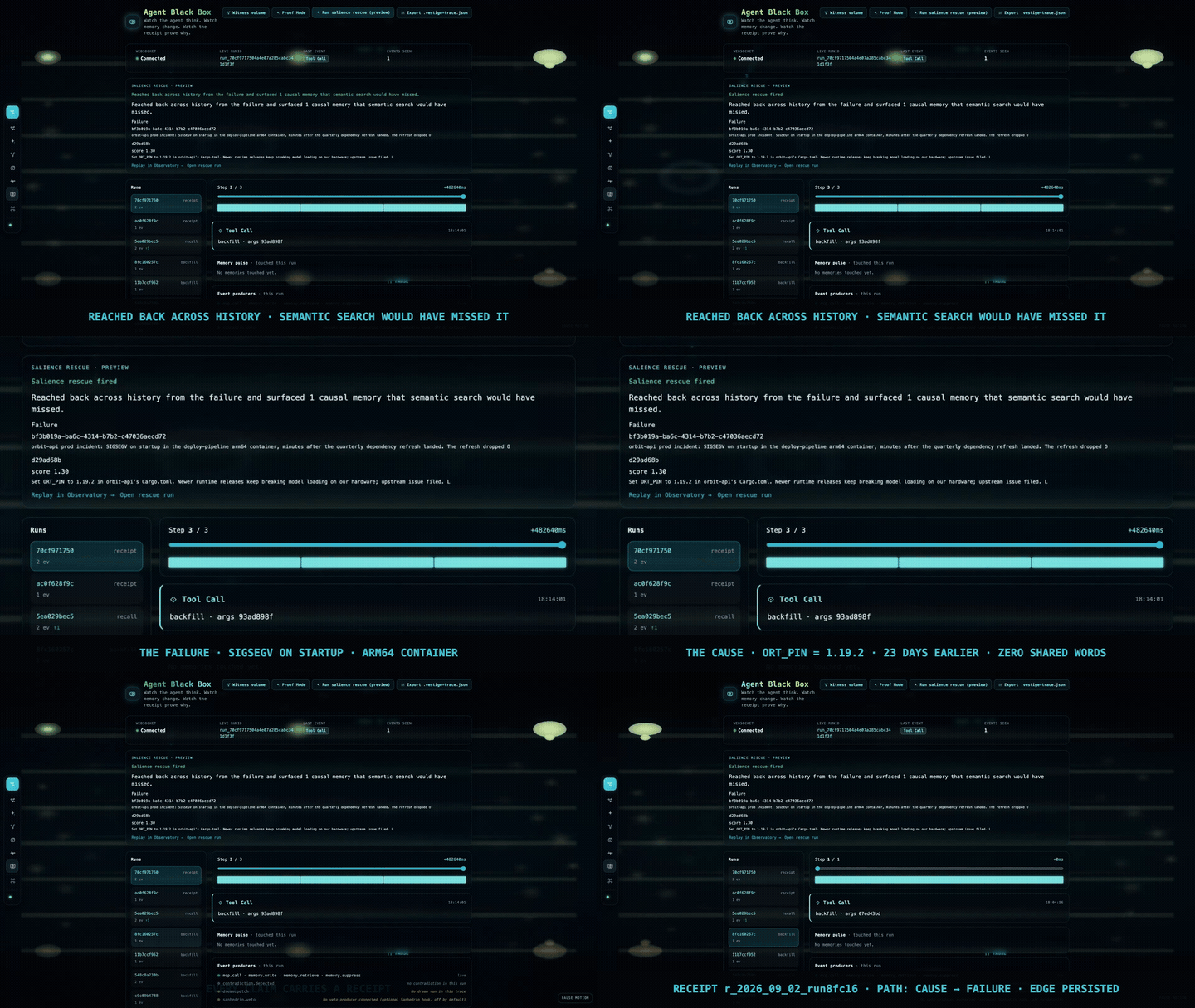
Recorded on v3.1 with vestige backfill --contrast. In 4.0 the backward walk is causal_walk, which follows only recorded edges from an explicit start point. Watch the walk.
Each release archive holds four binaries: vestige-mcp (the MCP server your agents run), vestige (the CLI), vestige-upgrade (the v3 importer) and vestige-restore. Keep all four in one folder. No Docker, no signup, no compile step, and nothing downloads on first start.
macOS and Linux. Two commands put the binaries in ~/.local/bin:
mkdir -p ~/.local/bin
curl -fsSL https://github.com/samvallad33/vestige/releases/latest/download/vestige-mcp-aarch64-apple-darwin.tar.gz | tar -xz -C ~/.local/bin
Use the archive for your machine:
| Machine | Archive |
|---|---|
| Mac with Apple silicon | vestige-mcp-aarch64-apple-darwin.tar.gz |
| Mac with Intel | vestige-mcp-x86_64-apple-darwin.tar.gz |
| Linux x86_64 (glibc 2.35+: Ubuntu 22.04, Debian 12 and newer) | vestige-mcp-x86_64-unknown-linux-gnu.tar.gz |
| Linux arm64 (same glibc floor) | vestige-mcp-aarch64-unknown-linux-gnu.tar.gz |
| Windows x86_64 | vestige-mcp-x86_64-pc-windows-msvc.zip |
Then check it:
vestige-mcp --versionIt should print vestige-mcp 4.0.0. If the shell says command not found, ~/.local/bin is not on your PATH yet: add export PATH="$HOME/.local/bin:$PATH" to ~/.zshrc (or ~/.bashrc) and open a new terminal. If it prints an older version, an older install comes first on your PATH; which -a vestige-mcp lists them.
On a Mac, download with curl as above rather than a browser. A browser marks the files as quarantined and macOS then refuses to run them. If you already used a browser, clear the flag with xattr -d com.apple.quarantine ~/.local/bin/vestige*.
Windows. Download vestige-mcp-x86_64-pc-windows-msvc.zip from the latest release, unzip all four .exe files into one folder, and add that folder to your PATH.
Homebrew (macOS and Linux): brew install samvallad33/tap/vestige.
Every archive has a .sha256 file beside it on the release page. Do not install this version with npm; the npm package is not 4.0.
Connect your agents. The MCP command is vestige-mcp:
| Client | Setup |
|---|---|
| Claude Code | claude mcp add vestige vestige-mcp -s user |
| Codex | codex mcp add vestige -- vestige-mcp |
| Cursor / VS Code / Windsurf | docs/integrations/ |
| Claude Desktop, and any other app you start from the Dock or Start menu | the JSON below, with the full path from which vestige-mcp (desktop apps do not read your shell's PATH) |
| Cline / Continue / Zed / Goose | the JSON below, in that client's MCP settings |
{
  "mcpServers": {
    "vestige": { "command": "vestige-mcp" }
  }
}
Use it from every agent at once. Claude Code in three terminals, Cursor, Codex and Claude Desktop can all run Vestige at the same time on one machine. The first one to start serves the store and the others connect to it, so every agent reads and writes the same memory through one writer. When that first agent quits, one of the others takes over and keeps its session.
vestige-mcp also takes --data-dir <PATH>, --http, --no-http, and --http-port <PORT> (default 3928, and passing the flag turns HTTP on). HTTP binds to 127.0.0.1 unless VESTIGE_HTTP_BIND is set. VESTIGE_AUTH_TOKEN overrides the bearer token. VESTIGE_HTTP_ALLOWED_ORIGINS is a comma-separated browser allowlist. VESTIGE_DASHBOARD_ENABLED=1 starts the dashboard from the server; VESTIGE_DASHBOARD_PORT defaults to 3927. VESTIGE_SYSTEM_PROMPT_MODE is minimal or full. RUST_LOG filters logs. VESTIGE_DATA_DIR is the data directory when --data-dir is absent. The Strata log lives in log/ inside that directory.
Optional output defaults live in <data-dir>/vestige.toml. A missing file uses the built-in defaults. An explicit MCP argument wins over the file.
[defaults]
profile = "default"       # lean | default | audit | research
detail_level = "summary"  # brief | summary | full
limit = 10
lean presets brief detail and a limit of 5. audit presets full detail. research presets full detail and a limit of 25. default leaves the historical tool limits alone.
Nothing leaves the machine by default. A default 4.0 build has no embedding model and no startup version check. source_sync (--features connectors) and vestige sync --cloud (--features cloud-sync) are the only calls that use the network, and neither feature is in a 4.0 release build. Full walkthrough: docs/GETTING-STARTED.md.
vestige --help lists the CLI. --data-dir is global.
Quit every app that runs Vestige v3 (each agent, the dashboard, any background job), point all of them at the 4.0 vestige-mcp, and start them again. A v3 server left running keeps writing to vestige.db, which 4.0 no longer reads after the upgrade.
Point 4.0 at your existing data directory. The first launch finds vestige.db, builds a Strata log from it next to the file, verifies that log against a signed migration receipt, and only then publishes it as log/. The v3 file is never modified. A backup copy is written first, owner-only.
What carries over: every memory with its scope, tags and scheduling state; links; supersession; suppression (suppressed memories stay hidden); intentions; and code anchors. Links v3 inferred by similarity come across as legacy_inferred history. They are kept, and they never count as recorded evidence.
On a real 297 MB store with 8,902 memories in 34 scopes, the first launch took about 17 seconds before the MCP handshake answered, and average retention right after the upgrade was 0.810 against 0.8105 computed by v3 itself. Agents that start during the upgrade wait for it and then connect; there is nothing to coordinate by hand.
If the upgrade fails, the v3 data is untouched and the message says so. You can keep using v3.1.1 meanwhile. vestige strata-verify <data-dir> checks the log and its migration receipt at any time.
If you installed v3 with npm, make sure your agents now run the 4.0 binary: vestige-mcp --version should print 4.0.0, and which -a vestige-mcp shows every copy on your PATH in the order they are found.
4.0 does not rank text that resembles your query. There are no embeddings, no BM25 and no keyword search in the default binaries. recall takes a handle: a memory id, a unique id prefix of 8 or more characters, or an exact tag. A free-text query returns similarity_disabled and asks for a handle.
| Resemblance search | Vestige 4.0 | |
|---|---|---|
| How a memory is found | Similarity to the query | An exact handle |
| What counts as a link | Anything that scores close | Only an edge the log recorded. Imported v3 links are marked legacy_inferred |
| Walking back from a failure | Nearest lookalikes | causal_walk from explicit start points (a failing test, a stack frame, a CI run, a logged write, a version range), backward over recorded edges, at most 8 hops and 500 nodes |
| Proof of a write | None | A receipt per write. receipt replay re-derives the state from the log |
| Unused memories | Persist at full weight | Fade under FSRS scheduling |
| Your data | Often a hosted index | A signed, append-only log in the data directory |
causal_walk never guesses. With no start point it returns needs_report and names what is missing. forgotten_lesson walks backward from a failure the same way and ranks fix or lesson memories by how far they have faded.
On a Strata log a write is proposed, checked by the gate, and admitted as an effect, and the call returns an eff- receipt. receipt get shows what that write did. receipt replay rebuilds the state from the log and reports any mismatch. selftest plants a known cause in a throwaway copy of your store and checks that the walk finds it, without touching the live store.
The Memory PR review modes from v3 (risk_gated, paranoid) are not available on a Strata log in 4.0. A review setting carried over from v3 reads as fast, and the dashboard's Memory PR list says review is unavailable.
Recorded run on v3.1: THE LIVE GATE.
maintain action backup copies the whole Strata log into <data-dir>/backups/ and reports its size. From a terminal, vestige backup <new-folder> does the same, and it works while your agents are running: it asks their Vestige server for the copy. To restore, stop Vestige and copy the backup's log/ back into the data directory.
The log has one writer. CLI commands that open it directly, such as vestige stats or vestige ingest, run only while no Vestige server holds the store, and they name the process that does. maintain action export writes every live memory as JSON or JSONL into <data-dir>/exports/.
Portable archives, file sync and hosted sync are not available on a Strata log in 4.0. The CLI says so when you call them.
Measured on v3.1, where recall still used hybrid search:
| Arm (6 models, 25 trials) | Converged correct | Converged wrong | Split |
|---|---|---|---|
| No memory | 0/25 | 21/25 | 4/25 |
| Dense cosine RAG | 4/23 | 12/23 | 7/23 |
| Vestige | 20/23 | 0/23 | 3/23 |
Outcomes come from tests/by_model_tables.py: a trial is correct when the tests were green, the production replay passed, and the key was right; wrong when the tests were green but production failed; split when the merge conflicted.
Write-up: docs/SCIENCE.md.
| Mechanism | In 4.0 | Source in the code |
|---|---|---|
| FSRS scheduling | Every card, native or imported, decays and strengthens under FSRS in the Strata kernel | strata-kernel fsrs |
| Memory dreaming | maintain actions dream and dream_compile replay recorded edges and strengthen co-activated ones |
dream, dream_compile |
| Active forgetting | suppress takes a memory out of every read and keeps its bytes |
suppress |
| Causal walk | Backward over recorded edges only, bounded and deterministic | causal_walk |
| Prediction-error gating, synaptic tagging, spreading activation, narrative edges, Retroactive Salience Backfill | In the v3 engine. The 4.0 default build does not use them, because each depends on similarity or inferred links | vestige-core (v3 engine) |
tools/list advertises these 16 tools, sorted by name. The list is compact: every field a call can send is on the wire with its type, prose and deep structure move one call deeper, and filter fields are grouped under filters and source (sent either grouped or flat). The serialized catalog is about 21 KiB. memory_status with view=tools lists every tool; set tool to a name for that tool's full input schema. Actions a Strata log cannot honor are left out of the schema and refused with the reason.
| Tool | Purpose |
|---|---|
causal_walk |
Walk a failure backward from explicit start points over recorded edges |
codebase |
Remember a pattern or decision with code anchors, fetch context marked current or stale, verify anchors against source, reanchor |
dedup |
scan for duplicates, undo a recorded operation, tag_rename and tag_merge with a preview, policy |
forgotten_lesson |
Faded fix or lesson memories behind a failure, over recorded edges |
graph |
chain, associations, bridges, predict, memory_graph, recent, never_composed, bounty_mode |
intention |
set, check, update, list. graph runs the evidence-aware plan |
maintain |
consolidate, dream, dream_compile, gc (dry run unless you turn it off), importance_score, backup, export |
memory |
get, get_batch, state, promote, demote, edit. Demote does not delete. An edit admits a successor and keeps its code anchors |
memory_status |
health, retention, timeline, changelog, provenance, coverage, stats, tools |
project |
Preview a fenced region of CLAUDE.md or MEMORY.md. write needs confirm=true and replaces only the fence |
recall |
Find memories by exact handle: id, unique prefix, or exact tag |
receipt |
get a receipt, or replay it against the log |
selftest |
Plant a known cause in a throwaway copy and check the walk finds it |
session_start |
Status, open intentions, predictions, and codebase context under one budget |
smart_ingest |
Store one memory, or up to 20 with items. Secrets are refused unless you say otherwise |
suppress |
Take a memory out of every read. The log keeps its bytes, and on Strata it cannot be undone. destructiveHint is true |
Withheld in 4.0. purge is the one tool 4.0 does not ship. On an append-only signed log a purge could hide a memory but not erase its bytes, and a tool called purge must not pretend otherwise. purge, memory action purge or delete, and delete_knowledge return unavailable_in_4_0. Real erasure is the 4.0.x follow-up.
Full contracts: docs/TOOL-CONTRACTS.md · Hygiene and standing habits: docs/MEMORY_HYGIENE.md
vestige dashboardThe server binds http://127.0.0.1:3927 and redirects / to /dashboard. It works while your agents are running: the Vestige server they share serves the dashboard until you press Ctrl+C. The observatory steps a fixed 60fps clock, 720 frames, 12 seconds, and can export that loop as an mp4. Share artifacts are structure-only: the shape of the store, not the memory text.
| Engine | Rust 2024. Release archives ship vestige, vestige-mcp, vestige-restore, and vestige-upgrade |
| Store | Strata: an append-only log of borsh frames, hash-chained; a sealed segment carries a signed trailer. Writes are proposed, gated and admitted; the state is re-derived by replaying the log. No SQLite is linked into the shipped binaries |
| Recall | Exact handles only. No embeddings, BM25, FTS or keyword matching |
| Size | vestige-mcp is about 7.7 MB on macOS arm64 |
| First run | Nothing to download. On a v3 data directory, the first launch runs the upgrade before the MCP handshake |
Getting Started · FAQ · The Science · Configuration · Storage · Tool contracts · Changelog
AGPL-3.0-only.