
Drop-in SNES hardware for your static recompilation project.
You write the recompiled game code. We give you real PPU rendering, SPC700 audio, DMA, Mode 7, and everything else the SNES had — as a linkable C library.
Your Recompiled Game Code
         |
         v
    bus_write8(0x00, 0x2118, val)   <-- writes to VRAM data port
         |
         v
    +-----------+
    | snesrecomp |  <-- this library
    +-----------+
         |
         v
    +------------+
    |  LakeSnes   |  <-- real SNES PPU/APU/DMA hardware (MIT licensed)
    +------------+
         |
         v
    SDL2 Window + Audio Output
Part of the recomp family (snesrecomp, gbarecomp, lynxrecomp, xboxrecomp,
ps3recomp, pcrecomp, ...) and follows the same house style: toolkit and game repos
kept apart, generated code never committed, --headless --record on every build, a
conformance harness against a reference.
Alpha. Unversioned. The hardware layer is LakeSnes and is complete; the
recompilation side (timed loop, lockstep validation, autogen.py) is new and
moving. Titles built on it:
| Title | Repo | State |
|---|---|---|
| Super Mario Kart | mk | Playable end to end (genuine ROM in the timed frame); recompiled shells growing |
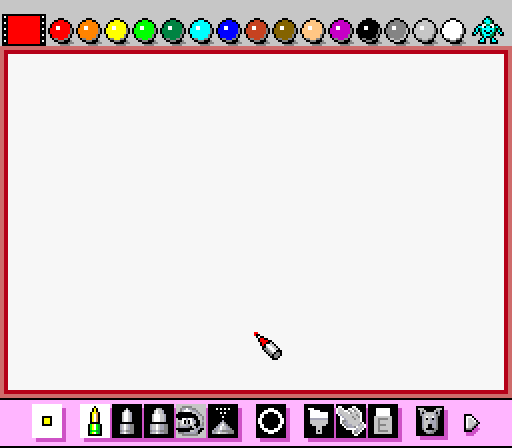
| Mario Paint | mariopaint | Title, canvas and bottom bar work; 57/103 hand-ports pass conformance |
| Stunt Race FX | stuntrace | Boots with Super FX (GSU-2 in the LakeSnes fork); game logic in progress |
The toolkit has no conformance harness of its own yet; the game repos carry theirs (see ROADMAP.md).
Mario Paint, running on snesrecomp:
Static recompilation takes a console game's machine code and converts it into equivalent native C code that runs on modern hardware. The hard part isn't recompiling the CPU instructions — it's providing the hardware those instructions talk to.
Every SNES game writes to the same PPU registers, the same APU ports, the same DMA channels. So why reimplement that for every single recomp project?
snesrecomp solves this by packaging a real, battle-tested SNES emulator's hardware backend (LakeSnes, forked from angelo-wf) as a linkable static library. Your recompiled code calls bus_write8(bank, addr, val) and gets real PPU behavior, real audio processing, real DMA transfers — all for free.
This is the same approach used by N64Recomp (which uses parallel-rdp for graphics) and other successful recomp projects. Chop up an emulator, turn the hardware into libraries, let game-specific projects link against them.
| Component | What it does | Status |
|---|---|---|
| PPU | Full scanline rendering, Mode 0-7, sprites, windows, color math, hi-res | Real (LakeSnes) |
| APU/SPC700 | Full SPC700 CPU + BRR audio DSP, 8 channels, echo, noise | Real (LakeSnes) |
| DMA | All 8 channels, GPDMA + HDMA, proper A-bus/B-bus routing | Real (LakeSnes) |
| Cartridge | LoROM, HiROM, ExHiROM auto-detection, SRAM, DSP-1 coprocessor | Real (LakeSnes) |
| CPU I/O | NMI/IRQ, multiply/divide ALU, joypad auto-read | Real (LakeSnes) |
| CPU State | 65816 register struct (A, X, Y, S, DP, DB, PB, flags) | Recomp adapter |
| 65816 Op Kit | cpu_ops.h — inline helpers for LDA, STA, REP/SEP, PHP/PLP, etc. |
Recomp utility |
| Memory Bus | 24-bit address routing to all hardware | Adapter over LakeSnes |
| Auto Dispatch | RECOMP_PATCH(name, addr) — recompiled fn auto-registers at SNES address before main() |
Recomp utility |
| Function Table | Hash-table dispatch for JSR/JSL indirection by SNES address |
Recomp utility |
| Platform | SDL2 window, renderer, audio output, frame timing | SDL2 |
| Input | Joypad + SNES Mouse + Super Scope, keyboard/mouse mapping, hardware auto-read | SDL2 + LakeSnes |
The toolkit is used from a game repo, and the game repo's README is the quick start (it fetches this repo as a submodule). To build the toolkit on its own:
git clone --recursive https://github.com/sp00nznet/snesrecomp.git
cd snesrecomp# Windows (MSVC + vcpkg)
cmake -B build -G "Visual Studio 17 2022" -A x64 \
-DCMAKE_TOOLCHAIN_FILE=C:/vcpkg/scripts/buildsystems/vcpkg.cmake
cmake --build build --config Debug
# Linux / macOS
cmake -B build
cmake --build buildPrerequisites: CMake 3.16+, a C11/C++17 compiler (Visual Studio 2022, GCC or
Clang), SDL2 (vcpkg install sdl2:x64-windows on Windows), and optionally
SDL2_ttf for the menu font. Clone with --recursive: LakeSnes is a submodule
and the build fails without it.
./build/Debug/snesrecomp_minimal "path/to/your/game.sfc"
./build/Debug/snesrecomp_minimal game.sfc --headless --record out.mp4   # no window
On Windows, copy SDL2.dll next to the exe.
# In your game's CMakeLists.txt:
add_subdirectory(ext/snesrecomp)

add_executable(my_recomp src/main.c src/game_functions.c)
target_link_libraries(my_recomp PRIVATE snesrecomp SDL2::SDL2main)#include <snesrecomp/snesrecomp.h>
/* A recompiled SNES function — this is what the original 65816 code becomes.
* RECOMP_PATCH defines the function and auto-registers it in the dispatch
* table at its original SNES bank:address before main() runs. No central
* registration list needed. */
RECOMP_PATCH(smk_808056, 0x808056) {
/* Original: LDA #$80 / STA $2100 (force blank on) */
CPU_SET_A8(0x80);
bus_write8(0x00, 0x2100, CPU_A8()); /* -> real PPU INIDISP register */
/* Original: STZ $4200 (disable NMI) */
bus_write8(0x00, 0x4200, 0x00); /* -> real NMI control register */
}
int main(int argc, char *argv[]) {
snesrecomp_init("Super Mario Kart", 3);
snesrecomp_load_rom(argv[1]);
while (snesrecomp_begin_frame()) {
/* Call recompiled functions directly... */
smk_808056();
/* ...or dispatch by SNES address (used by recompiled JSR/JSL). */
func_table_call(0x808056);
snesrecomp_end_frame(); /* renders PPU + presents */
}
snesrecomp_shutdown();
return 0;
}<snesrecomp/cpu_ops.h> (auto-included via snesrecomp.h) provides
inline helpers for the common 65816 instructions — op_lda_imm16,
op_sta_dp16, op_rep, op_sep, op_php/op_plp, etc. — that read
and write the global g_cpu state and route memory through the bus.
Pull from this kit when translating instruction sequences; extend with
project-specific ops as needed.
Every bus_write8 to a PPU register updates real PPU state. Every bus_read8 from an APU port reads real SPC700 output. DMA transfers move real data between real hardware components. You don't write any hardware emulation code — it's all already there.
- docs/architecture.md: the layers, the two run modes, design decisions.
- docs/runtime.md: command-line flags, environment variables, validation and profiling.
- tools/README.md: disassembler, call-graph crawler,
autogen.py.
Here's the general workflow:
- Get a disassembly of your target game (
tools/disasm65816.py,tools/callgraph.py) - Identify functions — find subroutine boundaries (JSR/JSL/RTS/RTL patterns)
- Recompile functions to C — wrap each in
RECOMP_PATCH(name, snes_addr) { ... }. Translate 65816 instructions using thecpu_ops.hop kit (op_lda_imm16,op_sta_dp16, …) and the bus functions. Auto-registration handles dispatch — no central list to maintain. - Wire up the main loop — call the game's entry point function each frame
- Link against snesrecomp — all hardware just works
Because RECOMP_PATCH registrations run at static-init time and the dispatch table just keeps the last writer, you can override any recompiled function by linking another translation unit that defines a RECOMP_PATCH at the same SNES address. Put mod objects after the originals in the link order and they win.
The Super Mario Kart recompilation and Mario Paint recompilation are projects using this library. Check them out for real-world examples.
As in Getting Started. A game repo builds it with add_subdirectory(ext/snesrecomp).
It also cross-builds with mingw-w64, which is how the netlab farm builds it:
cmake -S . -B build -G Ninja -DCMAKE_SYSTEM_NAME=Windows \
  -DCMAKE_C_COMPILER=x86_64-w64-mingw32-gcc -DCMAKE_CXX_COMPILER=x86_64-w64-mingw32-g++ \
  -DCMAKE_PREFIX_PATH=<SDL2 mingw devel folder>
cmake --build buildsnesrecomp contains no game data. You supply your own ROM, and anything
tools/autogen.py generates from it stays on your machine (gen/ is gitignored).
- LakeSnes by angelo-wf (used through the sp00nznet fork) — the excellent pure-C SNES emulator that provides all hardware emulation. MIT licensed.
- Dear ImGui: the menu overlay. MIT licensed.
- stb_image_write: screenshots. MIT / public domain.
- SDL2 — cross-platform multimedia. zlib licensed.
- sp00nznet — library design, adapter layer, and the recomp projects that use it.
MIT, see LICENSE. Third-party code (LakeSnes, Dear ImGui,
stb_image_write) keeps its own licence; see NOTICE and LICENSES/.
Contributions: CONTRIBUTING.md.